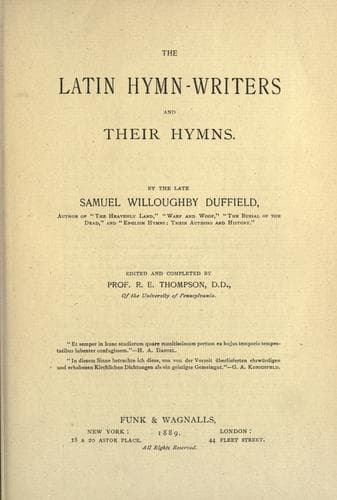
The Latin Hymn-writers and Their HymnsDuffield, Samuel Willoughby
Religion
The Latin Hymn-writers and Their Hymns
Duffield, Samuel Willoughby
Hymns, Latin -- History and criticism
Yet Prudentius, the Spaniard, was a classic survival in Spain. And
Damasus, the pope, was associated with certain dramatic scenes. And
Venantius Fortunatus, troubadour and bishop, furnishes us with a most
striking portrait of the times in his attachment to the abbess-queen,
Radegunda. The list presumably includes Elpis, the wife of Boethius, the
“last of the Romans;” and Coelius Sedulius, the Briton; and Gregory the
Great and the great archbishop, Rabanus Maurus, and perhaps Robert II.
of France. It calls into fresh life the histories of the Venerable Bede
and of Alcuin; of the two Bernards, the one of Clairvaux and the other
of Cluny; of Peter the Venerable and of Abaelard and Heloise; of Adam of
St. Victor, and Thomas of Celano; of Bonaventura and Aquinas and à
Kempis and Xavier. It shows us that mad Solomon, poor Jacoponus; and it
leaves us with verses from John Huss, the martyr, to be read by the
light of the Reformation’s dawn.
Thus largely does the subject of the Latin hymns traverse the ages. From
the fourth to the sixteenth centuries of the Christian era it is the one
stream which was fed from Alpine or from Pyrenean snows—a “river of God
that is full of water,” which expands into the stately movement of the
Notkerian and Gottschalkian sequence, or gently murmurs its song of
trust with the missionary Xavier as he writes the exquisite melody of
that hymn, _O Deus, ego amo te!_ To understand and to love these lyrics
is to be better fitted for this nineteenth century of praise. Not the
persecutors and the injurious, not the cruel and the cold-hearted will
then remain to us; but the _Dies Irae_ will utter its trumpet-voice
above the dead phrases of a formal service, and the _Salve caput
cruentatum_ will call us afresh to the foot of the cross.
CHAPTER III.
HILARY OF POITIERS AND THE EARLIEST LATIN HYMNS.
When Master Peter Abaelard was preparing his own hymns for use in the
Abbey of the Paraclete, he prefaced them with a brief treatise. There
were ninety-three of them, arranged for all the services of Heloise and
her nuns, and he answers the request of his abbess-wife by sending them,
somewhere in the neighborhood of the year 1135. “At the instance of thy
requests, my sister Heloise,” he writes, “formerly dear in the world and
now most dear in Christ, I have composed what are called in Greek,
‘hymns,’ and in Hebrew, ‘tillim.’” For it is plain that she has a vivid
recollection of his “wild, unhallowed rhymes, writ in his unbaptized
times,” and she would now have him tune his lyre, as Robert Herrick did,
to a loftier strain.
Hence he made for these gentle sisters a hymn-book of their own, and so
became the Watts or Wesley of their matins and vespers. With
characteristic self-confidence he only included what he had himself
prepared; but this introduction casts a great deal of light upon the
knowledge and piety of the time respecting hymns.
Public-domain text, read in full here on John Shaqi.
Reviews
Reviews
No reviews yet
Be the first to share your thoughts on this work.
Join the Discussion
Join the discussion
Sign in to leave a comment or review.
Sign InorCreate an account