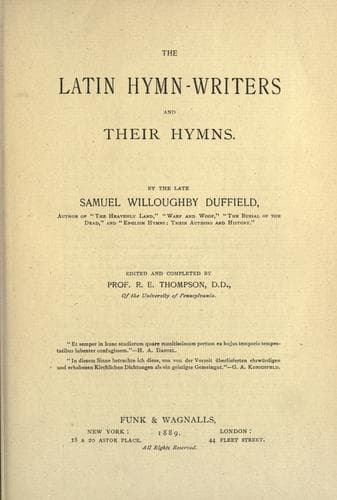
The Latin Hymn-writers and Their HymnsDuffield, Samuel Willoughby
Religion
The Latin Hymn-writers and Their Hymns
Duffield, Samuel Willoughby
Hymns, Latin -- History and criticism
“I remember,” continues Abaelard, “that you asked me for an explanation.
‘We know,’ you said, ‘that the Latin, and especially the French Church,
have in psalms, and also in hymns, followed more a custom than an
authority.’” This was quite true; and the remark is eminently
characteristic of Heloise, whose scholarship was admirable, and whose
disposition was of a sort to crave for and cling to a stronger nature.
He then quotes for her the decree of the fourth Council of Toledo (A.D.
633), by which Hilary of Poitiers and Ambrose of Milan are established
as the great fathers of Christian song in the Western Church, and by
which the praise of God in hymns is sanctioned and commended.
To much the same effect are the words of Augustine of Hippo, centuries
earlier. His beloved mother, Monica, had died, and nothing appeared to
comfort him so much as one of these same holy songs. “Then I slept, and
woke up again and found my grief not a little softened; and as I was
alone in my bed, I remembered those true verses of thy Ambrose. For thou
art the
“‘Maker of all, the Lord
And Ruler of the height,
Who, robing day in light, hast poured
Soft slumbers o’er the night,
That to our limbs the power
Of toil may be renewed,
And hearts be raised that sink and cower,
And sorrows be subdued.’”
This is the _Deus creator omnium_ of the great bishop of Milan; and
this, in consequence of Augustine’s quotation, is among the best
authenticated and earliest hymns of the Latin Church.
But there were more ancient hymns than the Ambrosian or Augustinian.
They bear the name of Hilary, and with them Latin hymnology really
begins. It is true that in the previous century—the third—Cyprian of
Carthage had written religious poetry, but he composed nothing which
could be sung. There is, indeed, nothing previous to Hilary.
And now let us go back to the creation of this first and noblest light.
For Hilary had been a heathen—a heathen of the heathen—in Roman Gaul. He
was born in Poitiers (Pictavium) about the beginning of the fourth
century. His father’s name was Francarius, whose tomb—although he must
at first have lived as an idolater—is said by Bouchet to have been “for
upward of fifteen hundred years” in the parish church of Clissonium
(Clisson, near Nantes). We are indebted to Jerome for the main facts of
Hilary’s life, and to Fortunatus for a large share in the filling up of
the outlines. Hilary was so celebrated a man that contemporary
references are more abundant and helpful in his career even than in that
of Shakespeare. In those days he was at the summit of renown, a notable
exception to the case of the prophet, “not being without honor save in
his own country.” “For who,” says Augustine, “does not know Hilary the
Gallic bishop?” And Jerome wrote to St. Eustacia that Hilary and Cyprian
were the “two great cedars of the age.”
Public-domain text, read in full here on John Shaqi.
Reviews
Reviews
No reviews yet
Be the first to share your thoughts on this work.
Join the Discussion
Join the discussion
Sign in to leave a comment or review.
Sign InorCreate an account