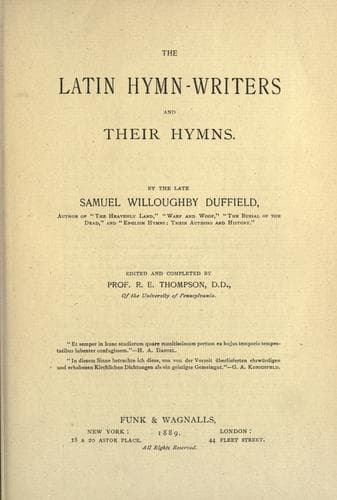
The Latin Hymn-writers and Their HymnsDuffield, Samuel Willoughby
Religion
The Latin Hymn-writers and Their Hymns
Duffield, Samuel Willoughby
Hymns, Latin -- History and criticism
which Dr. Ray Palmer has made familiar to American worshippers by his
exquisite version, first published in the _Andover Sabbath Hymn-Book_:
O Bread to pilgrims given.
Moll denies that Thomas wrote this, and says it is by a Jesuit poet,
which is most probable. March calls it “a happy echo” of the undisputed
hymns of Thomas Aquinas. But the echo is softened; the hymn is less
masculine. _Lympha fons_ alone would serve as a note to show that
Aquinas never wrote it.
It has been said by Dr. Neale that the
_Pange, lingua, gloriosi_
“contests the second place among those of the Western Church, with the
_Vexilla Regis_, the _Stabat Mater_, the _Jesu dulcis memoria_, the _Ad
Regias Agni Dapes_, the _Ad Supernam_, and one or two others, leaving
the _Dies Irae_ in its unapproachable glory.” But this judgment is the
prejudiced one of a High Churchman, sufficiently in sympathy with the
Roman doctrine of the sacraments to relish keenly Thomas’s concise and
vigorous statement of that doctrine, and to mistake the relish for
critical appreciation of the poetry. Dr. Neale even praises Thomas’s
treatise _On the Venerable Sacrament of the Altar_ as the finest
devotional treatise of the Middle Ages, finer therefore than the
_Imitation_ itself! A calmer estimate will put the hymn decidedly below
Bernard’s exquisite _Jesu dulcia memoria_, or the _Veni, Creator
Spiritus_ of Rabanus Maurus, or the _Veni, Sancte Spiritus_ of Hermann
Contractus. It is true that it excels all these in its peculiar
qualities, its logical neatness, dogmatic precision, and force of almost
argumentative statement; but these qualities are not poetical. In this
respect it is not altogether unlike Toplady’s “Rock of Ages,” a hymn in
which the intellect has cut a channel for the emotions to flow. That was
written as a tail-piece to a controversial article in which Toplady
discussed John Wesley’s doctrines in the matter of faith and works, and
is a terse statement of theological discriminations on that point.
Public-domain text, read in full here on John Shaqi.
Reviews
Reviews
No reviews yet
Be the first to share your thoughts on this work.
Elsewhere in the archive
Join the Discussion
Join the discussion
Sign in to leave a comment or review.
Sign InorCreate an account