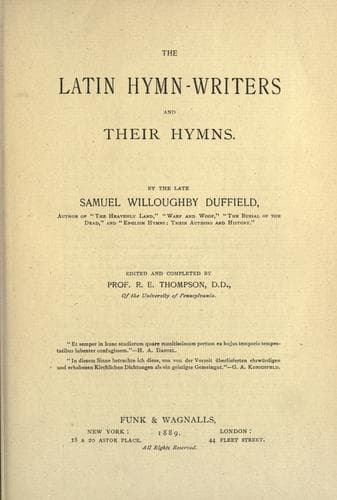
The Latin Hymn-writers and Their HymnsDuffield, Samuel Willoughby
Religion
The Latin Hymn-writers and Their Hymns
Duffield, Samuel Willoughby
Hymns, Latin -- History and criticism
Thomas’s Franciscan friend, John Fidenza, better known by his nickname
of John Bonaventura, was a hymn-writer also, but he did a good many
other things better. To many Protestants his name has been made
offensive through its association with the _Psalter of Our Lady_, a
travesty of the Book of Psalms, with which he had nothing to do, and
which was made in a later century. Indeed, as Martin Chemnitz pointed
out three centuries ago, Bonaventura protested against the excessive
reverence for the Virgin, which had already become common, as likely to
lead to idolatry. That he was called the Seraphic Doctor shows that men
felt in him a warmth of heart and a tenderness of devotion, which they
missed in his greater contemporary, Thomas Aquinas, the Angelical
Doctor. Indeed he was the incarnation of the Franciscan spirit of love
and helpfulness, as Thomas of the Dominican spirit of theological
research and orthodox defence. Yet Bonaventura’s _Breviloquium_ has been
praised by good judges as the best compend of Christian doctrine that
the Middle Ages have left us.
Bonaventura’s Latin poems are rather devout meditations than hymns. They
are not the voice of the Christian congregation in song, but of the monk
meditating before his crucifix. To him is sometimes ascribed the
Christmas hymn,
_Adeste fideles,_
but not on sufficient authority. His best known hymns are the
_Christum Ducem, qui per crucem,_
and
_Recordare sanctae crucis,_
of which latter we have English versions by Dr. Henry Harbaugh, Dr. J.
W. Alexander, and E. C. Benedict. Five other hymns are ascribed to him
in the collections. They all have the Franciscan note; they turn on our
Lord’s human sympathy and sufferings. This explains the ascription to
him of a long hymn on the members of our Lord’s body as affected by the
passion, which is found in Mone (I., 171-74), but which is more
frequently and quite as erroneously ascribed to Bernard of Clairvaux. It
is not worthy of either, although Mone thinks the ascription to
Bonaventura “worthy of attention.” The hymn furnishes the point of
contact of the Latin hymnology with that of the later Moravians, the
Franciscans of Protestantism.
So we leave the two great scholars, thinkers, doctors, and poets, each
representing one of the two chief streams of spiritual influence in the
Church of the thirteenth century. “They were lovely and pleasant in
their lives, and in death they were not divided.”
CHAPTER XXV.
JACOPONUS AND THE “STABAT MATER.”
Public-domain text, read in full here on John Shaqi.
Reviews
Reviews
No reviews yet
Be the first to share your thoughts on this work.
Elsewhere in the archive
Join the Discussion
Join the discussion
Sign in to leave a comment or review.
Sign InorCreate an account