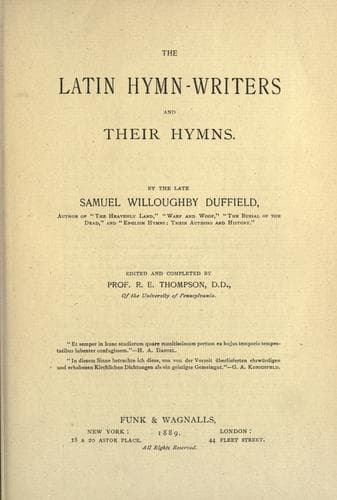
The Latin Hymn-writers and Their HymnsDuffield, Samuel Willoughby
Religion
The Latin Hymn-writers and Their Hymns
Duffield, Samuel Willoughby
Hymns, Latin -- History and criticism
Jacoponus, known to us sometimes as Jacobus de Benedictis, and sometimes
as Jacopo di Benedetto, or as Giacopone da Todi from his Italian
birthplace, is a most quaint and singular singer. The name Jacoponus is
a mere title of reproach, and signifies either “Big James” or “Silly
James.” It was called after him on the street and he adopted it in a
spirit of humility and as a badge of self abnegation. The man himself
was an Italian jurist and nobleman, who lived in the thirteenth century.
He led a wild life, lost his property, and eventually regained it by
industry and ability. Evidently he neither cared nor scrupled about his
ways of making money. A crisis came in his life in consequence of his
wife’s sudden death. She was killed at the city games of Todi in the
year of grace 1268, where with other women she had been watching the
sports from a scaffold of wood. It was insecure and fell, killing her
instantly. Poor Benedetto, on hurrying to the spot, found that beneath
her garments she had been wearing a hair girdle next to the
skin—according to the harsh custom of the time—and he was deeply
affected by this evidence of her anxiety to please God. In those days
such an action spoke volumes for the victim’s piety, and no one was more
open to conviction than this erratic, sensitive, and brilliant man.
But it would seem that for a long time he struggled against his
feelings, since we have a record that by 1298 he had been a religious
person about twenty years. Indeed, there is a story that he was not
received at once by the Minorites, and that he finally produced certain
poems before they grew satisfied to take him in. However, when he was
fairly within their walls he outdid all the other Franciscans in
austerity. He had given up his position as Doctor of Laws and had
surrendered his property; now it would appear that he was determined to
advance beyond the rest in ascetic devotion. His penances and prayers
were greatly in excess of prescribed rules, and he must have proved as
sore a trial to any easy-going brother, as Simeon Stylites was when he
too led the whole convent to denounce his ascetic habits. There is small
doubt that the brain of Jacoponus was decidedly off its balance, even in
these earliest days, and his subsequent conduct gave full evidence of
his insanity. Still, we find in this self-abasement of his nothing that
looks like pride or egotism. Where others display a complacency which is
very Pharisaic, he only shows the monomania of a gifted soul. Some of
his expressions are remarkable for their spiritual depth and power. Thus
when he was pressed to explain how a Christian can be sure that he loves
God, he replied, “I have the sign of charity; if I ask God for
something, and He refuses me, I love Him notwithstanding; and when He
opposes me I love Him twice as much.” “I would,” he says, “for the love
of Christ, suffer with a perfect resignation all the toils of this life,
Public-domain text, read in full here on John Shaqi.
Reviews
Reviews
No reviews yet
Be the first to share your thoughts on this work.
Elsewhere in the archive
Join the Discussion
Join the discussion
Sign in to leave a comment or review.
Sign InorCreate an account