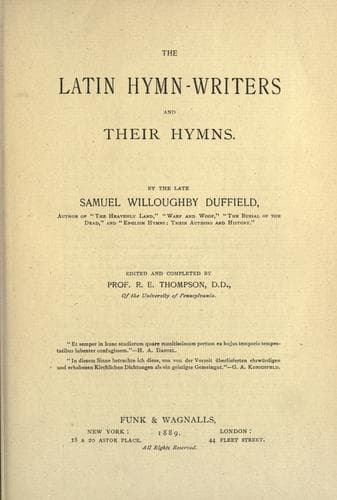
The Latin Hymn-writers and Their HymnsDuffield, Samuel Willoughby
Religion
The Latin Hymn-writers and Their Hymns
Duffield, Samuel Willoughby
Hymns, Latin -- History and criticism
every grief, anguish, pain, which word can express or thought conceive.
I would also readily consent that, on leaving life, the demons should
bear my soul into the place of tortures, there to endure all the
torments due to my sins; to those of the just who suffer in purgatory,
and even of the reprobates and demons if this could be; and that until
the day of the last judgment, and longer still, according to the good
pleasure of the Divine Majesty. And, above all, it would be to me a
great pleasure and supreme satisfaction that all those for whom I should
have suffered should enter heaven before me, and, finally, if I came
after them that all should agree to declare to me that they owe me
nothing.” Surely no modern theologian has ever stated the doctrine of
“self-emptiness” in any shape which at all compares with this!
Nor was he deficient in wit. “I enjoy the realm of France,” he once
said, “more than does the King of France; for I take part in all the
happiness that comes to him and I haven’t the care of his business.” At
another time he entered the market-place on all fours naked, a saddle on
his back and a bit between his teeth, for what symbolic purpose no one
has ever explained. Again, he literally tarred and feathered himself,
covering his body with a sticky oil and then rolling in feathers of
various colors and kinds. In this elegant wedding attire he made his
appearance at his brother’s house to honor the marriage of his niece.
The guests, as might be expected, departed in confusion and disgust. But
to all remonstrances upon his conduct he retorted, “My brother thinks to
illumine our name by his magnificence; I shall do it by my folly.” He
was really a leaf taken out of Rabelais or Boccaccio—a jester whose
folly and wisdom were mingled unequally, much in the fashion of that
Wamba son of Witless, immortalized for us in the pages of _Ivanhoe_.
The man’s great mind had doubtless been shaken by his affliction and by
the gloomy theology of his time. Otherwise these performances, so
inconsistent with his genius, could never have taken place. The
irregularity of his productions, sometimes delicate as the most graceful
stanzas of the troubadours, and some times as coarse and rough as Villon
at his worst, are in exact proof of this assertion.
Public-domain text, read in full here on John Shaqi.
Reviews
Reviews
No reviews yet
Be the first to share your thoughts on this work.
Elsewhere in the archive
Join the Discussion
Join the discussion
Sign in to leave a comment or review.
Sign InorCreate an account