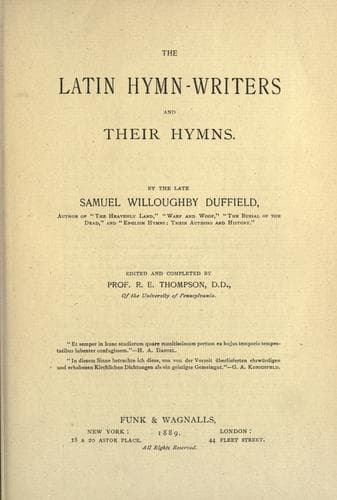
The Latin Hymn-writers and Their HymnsDuffield, Samuel Willoughby
Religion
The Latin Hymn-writers and Their Hymns
Duffield, Samuel Willoughby
Hymns, Latin -- History and criticism
In theology he was, to quote Ozanam, “no longer a dogmatic but a
mystic.” He really became the leader of a band of pure and elevated
minds which continued, by direct genealogy, through Hugo and Richard of
St. Victor, and Tauler down to St. Theresa, Madame Guyon, Fénelon, and
our own Thomas C. Upham. It is an honor of no slight consequence to have
inspired so much of the spirit of the Apostle John into that turbid
current of mediaeval religion. And it does not surprise us, therefore,
to find the _Cur mundus militat_ of Jacoponus credited to Bernard of
Clairvaux, nor the _Jesu, dulcis memoria_ of Bernard attributed to
Jacoponus. The two men were very similar, but the opportunities of the
French abbot were infinitely superior to those of the Italian monk. And
after a very careful inquiry I remain convinced, like other
hymnologists, that these two great hymns have already been properly
assigned. It is certainly a staggering piece of testimony when the
latter is found in an old MS. of Jacoponus’s poems, precisely in the
form in which it appears in the most critical edition of the writings of
Bernard. And it is equally unsettling for us to come upon the _Cur
mundus militat_ in the works of the saint, when we know, on no doubtful
evidence, that this was the passport of the sinner into his Franciscan
convent. Once more it is worth our while to repeat the warning that any
positive designation of Latin hymns by their authors’ names must rest
upon a firmer foundation than the mere fact that they can be discovered
in this man’s or that man’s printed works.
Jacoponus also interests us in view of his Protestant spirit. He never
fancied Boniface VIII., and when that pope had a dream in which he saw a
great bell without a tongue, and consulted the keen-witted friar upon
its meaning, he received the reproof valiant, “Know, your holiness,”
said the undaunted monk, “that the great size of the bell signifies the
pontifical power which embraces the world. But take heed lest the tongue
be that good example which you will not give.” For this and other
liberties which he took it is no wonder that he presently found himself
in prison, where he suffered everything patiently, and announced that he
would go out when Boniface was ready to come in. And this, indeed,
actually occurred. He was excommunicated, too, but from this sentence
Benedict XI. released him on December 23d, 1303.
Public-domain text, read in full here on John Shaqi.
Reviews
Reviews
No reviews yet
Be the first to share your thoughts on this work.
Elsewhere in the archive
Join the Discussion
Join the discussion
Sign in to leave a comment or review.
Sign InorCreate an account