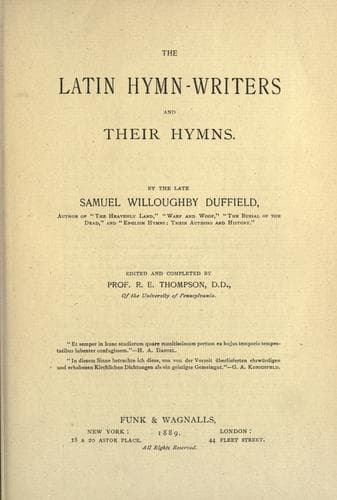
The Latin Hymn-writers and Their HymnsDuffield, Samuel Willoughby
Religion
The Latin Hymn-writers and Their Hymns
Duffield, Samuel Willoughby
Hymns, Latin -- History and criticism
I cannot refrain from quoting some more of his religious aphorisms and
meditations which instinctively suggest to us the pious musings of À
Kempis. Here is one: “I have always thought, and I think now, that it is
a great thing to know how to enjoy God. Why? Because in these hours of
joy, humility is exercised with respect. But I have thought, and I think
now, that the greatest thing is to know how to rest deprived of God.
Why? Because in these hours of trial, faith is exercised without
evidence, hope without attempt at fulfilment, and charity without any
sign of the divine benevolence.” And here is a fragment from his last
poem: “Love, I see that thou art transfiguring me, and making me become
Love like thee, so that I dwell no longer in my own heart and that I
know no longer how to find myself again. If I perceive in a man any
evil, or vice, or temptation, I am transformed and I enter into him; I
am penetrated with his pain.”
It must not be supposed that these poems were in the Latin language in
every instance. Very few of the entire number are truly within our own
sphere of research, and all those composed in Italian are accessible to
us only through a French prose translation. But his “Praise of Poverty”
deserves a place even in these pages, for it reveals the nature of the
poet and helps us to comprehend the pathos and tenderness of his
unregulated genius:
“Sweet Poverty, how much in truth
Should we love thee!
For, child, thou hast a sister named
Humility.
A common bowl, for food and drink,
Is all thy need;
Bread, water, and a few poor herbs,
Suffice indeed.
“And, if a guest should come, she adds
A pinch of salt;
She travels fearless, and no foe
Can bid her halt;
Thieves do not plunder her; she dies
At length in peace;
She makes no will; no grasping hands
Clutch her increase.
“Poor little thing! Behold thou art
Heaven’s citizen;
No vulgar earthly wishes draw
Thee down to men;
Thine is the greatest sceptre, thine
The kingdom here,
For what thou carest not to seek
Still crowdeth near.
“O science most profound and deep!
For thus we rise,
And gain our freedom by the things
We most despise!
O gracious Poverty, supplied
With joy and rest,
Thine is the plenty of the heart,
And that is best!”
Public-domain text, read in full here on John Shaqi.
Reviews
Reviews
No reviews yet
Be the first to share your thoughts on this work.
Elsewhere in the archive
Join the Discussion
Join the discussion
Sign in to leave a comment or review.
Sign InorCreate an account