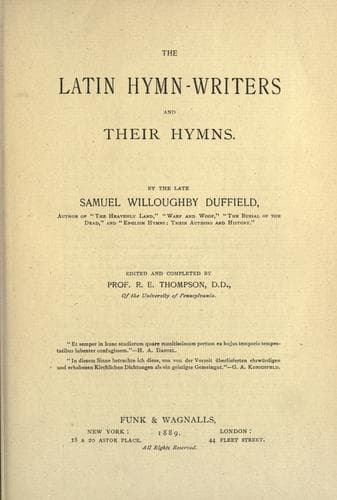
The Latin Hymn-writers and Their HymnsDuffield, Samuel Willoughby
Religion
The Latin Hymn-writers and Their Hymns
Duffield, Samuel Willoughby
Hymns, Latin -- History and criticism
Thomas survived his brother by nearly forty years. His cloister life
moved on through three decades with the external monotony of an
existence subjected to rule. Five years of the forty were years of
pestilence and popular distress, which he duly chronicles. But the only
real interruption of his routine which still has a living interest was
his acquaintance with young Johan Wessel, who came to pursue his studies
in Zwolle, being drawn by the charm of the _Imitation_ into the
neighborhood of its author. This probably was about 1460, when he sought
and made Thomas’s acquaintance, and often conversed with him upon the
greatest of themes. But the earliest biography of Wessel belongs to the
next century, and is by a Protestant pastor in Bremen; so the statements
that Wessel found Thomas and his brother monks all too superstitious,
and rebuked the Mariolatry of the author of the _Imitation_, are open to
doubt. That Wessel, the forerunner of Luther, influenced Thomas in the
writing of the _Imitation_ is a palpable absurdity.
For a short time he was procurator or steward of the monastery, a task
which must have been uncongenial to him, but which he would discharge
with his best diligence, as his first biographer, Jodocus Badius
Ascensius, says he did. Then he was sub-prior a second time in 1448.
The chronicle of Mount St. Agnes ends with January 17th, 1471; its
author died July 26th of the same year. His health had been singularly
good, but toward the close of his life he suffered from dropsy. His
eyesight never failed him, and he retained all his faculties in full
vigor to the last. As the end drew near, the sense of all he had been to
his brethren as a friend and counsellor deepened in them at the prospect
of losing him. All that their love could do and his ascetic principles
would permit, they did to lighten the burdens and relieve the pains of
his illness. He died in his ninety-second year, after having been
sixty-three years in the order and fifty-eight in the priesthood.
Public-domain text, read in full here on John Shaqi.
Reviews
Reviews
No reviews yet
Be the first to share your thoughts on this work.
Elsewhere in the archive
Join the Discussion
Join the discussion
Sign in to leave a comment or review.
Sign InorCreate an account