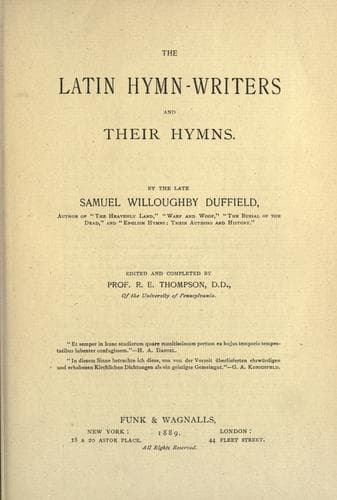
The Latin Hymn-writers and Their HymnsDuffield, Samuel Willoughby
Religion
The Latin Hymn-writers and Their Hymns
Duffield, Samuel Willoughby
Hymns, Latin -- History and criticism
He was buried within the cloisters of the monastery. There his bones
continued to rest even after the dissolution of the monastery at the
Reformation in 1573, and thence they were disinterred in 1672 and placed
in a shrine. But no miracles were wrought at his grave or by his bones.
Whatever the faults of the Brethren of the Common Life, it was not in
the atmosphere of the modern devotion that men learned to crave after
such evidence of sanctity in the servants of God. So the brotherhood and
its affiliated order have made no contributions to the list of Roman
Catholic saints. There is room in that long and motley list for Giovanni
da Capistrano, the cruel and implacable inquisitor, whose path across
Europe was marked with blood and fire. But none has been found for the
gentle and loving Thomas à Kempis, who has wooed millions of souls to a
closer communion with his Master, and whose own life preached humility,
patience, gentleness, renunciation of the world, conformity to the will
of God, and likeness to Christ, as distinctly as does his great book.
Well, he is content. _Ama nesciri_—love to be unknown—was a precept
often on his lips and illustrated in his life. Of small matter to him
would have been the attempt to deny his authorship of the _Imitation_,
and the controversy of two centuries’ duration it provoked. Of no
greater moment the refusal of the name of saint to one whose only
miracles were wrought upon the spirits of his brethren. But the Church
catholic says of him, “Surely this was a holy man of God.”
Public-domain text, read in full here on John Shaqi.
Reviews
Reviews
No reviews yet
Be the first to share your thoughts on this work.
Elsewhere in the archive
Join the Discussion
Join the discussion
Sign in to leave a comment or review.
Sign InorCreate an account