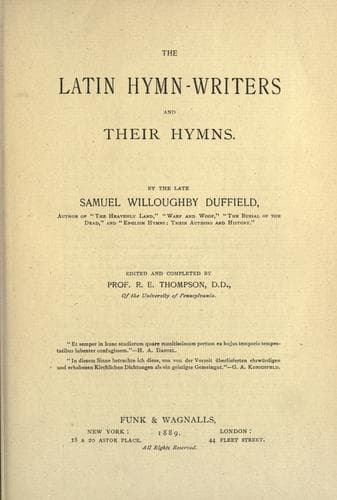
The Latin Hymn-writers and Their HymnsDuffield, Samuel Willoughby
Religion
The Latin Hymn-writers and Their Hymns
Duffield, Samuel Willoughby
Hymns, Latin -- History and criticism
Thomas à Kempis’s works as a whole fit into the writings of this group
of disciples of Gerard Groote, just as his _Imitation of Christ_ fits
into the rest of his works. He simply is the best writer they had, as
the _Imitation_ is the best thing he ever wrote. If none of the many
manuscripts of the _Imitation_ bore his name, as nearly all of them do;
and if none of the contemporaries who knew him had certified to his
authorship of it, as so many of them do; and if none of the printed
editions bore his name, as twenty-one of the fifteenth century and forty
of the sixteenth do, we still would have been obliged to ascribe it to
him. No other century than his could have produced it. It reflects the
ideas of no other group than that of the disciples of Gerard and
Florens. The very title, _De Imitatione Christi, et de Contemptu Omnium
Vanitatum Mundi_, expresses the twofold aspect of the _moderna devotio_
of which Gerard and Florens were the sponsors. Among those disciples
there is no one but the author of the _Soliloquy of the Soul_ and the
_Valley of Lilies_, to whom we could give it. It differs no more in
point of worth from Thomas’s other books than does the _Pilgrim’s
Progress_ from Bunyan’s other writings, _Grace Abounding_ always
excepted.
While it is by his formal hymns Thomas à Kempis acquires his right to a
place here, it is true at the same time that the _Imitation_ itself is a
great Christian poem, not only in substance but in form. A Belgian, who
was his contemporary, says he had written the book _metrice_, or in
rhythm and rhyme. As it was printed always as prose until our own times,
this statement was somewhat puzzling, as was the title, _Musica
Ecclesiastica_, found in some of the manuscripts. But Rev. Karl Hirsche,
Lutheran pastor in Hamburg, has vindicated both expressions by showing
that Thomas has followed such models as the sequence, _Victimae
paschali_, in the composition of his work. And he has given us an
edition based on Thomas’s autograph of the year 1441, in which this
peculiarity is made visible.[15] It is true that this way of writing
what we may call rhymed and rhythmical prose is not confined to Thomas
or to the _Imitation_ among his works. Among others Jan van
Schoonhooven, a Belgian disciple of Jan Rusbroek’s, uses this form
frequently; and Pastor Hirsche has pointed out its frequency in others
of Thomas’s works. But in no other book approaching the _Imitation_ in
length is the restriction of rhythm and rhyme so steadily accepted. As
an instance, take this brief passage from the fifth chapter of the third
book:
Public-domain text, read in full here on John Shaqi.
Reviews
Reviews
No reviews yet
Be the first to share your thoughts on this work.
Elsewhere in the archive
Join the Discussion
Join the discussion
Sign in to leave a comment or review.
Sign InorCreate an account