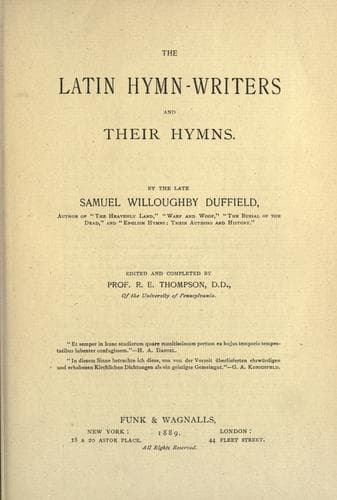
The Latin Hymn-writers and Their HymnsDuffield, Samuel Willoughby
Religion
The Latin Hymn-writers and Their Hymns
Duffield, Samuel Willoughby
Hymns, Latin -- History and criticism
“Amans volat, currit, et laetatur;
Liber est, et non tenetur
Dat omnia pro omnibus,
Et habet omnia in omnibus;
Quia in uno summo super omnia quiescit
Ex quo omne bonum fluit et procedit.
Non respecit ad dona
Sed ad donantem se convertit super omnia bona.
Amor modo saepe nescit,
Sed super omnem modum fervescit.
Amor onus non sentit,
Labores non reputat;
Plus affectat quam valet;
De impossibilitate non causatur
Quia cuncta sibi posse et licere arbitrator.”
Or in Rev. W. Benham’s admirable version: “He who loveth flyeth,
runneth, and is glad; he is free and not hindered. He giveth all things
for all things, and has all things in all things, because he resteth in
One who is high above all, from whom every good floweth and proceedeth.
He looketh not for gifts, but turneth himself to the Giver, above all
good things. Love oftentimes knoweth no measure, but breaketh out above
all measure; love feeleth no burden, reckoneth not labors, striveth
after more than it is able to do, pleadeth not impossibility, because it
judgeth all things which are lawful for it to be possible.”[16]
The _Imitation_ has obtained a place next to the Bible in the devotional
literature of Christendom. The fact that the author was a Roman Catholic
and that the fourth book is a preparation for the devout reception of
the Eucharist in accordance with the Roman Catholic theory of its
nature, has not prevented stanch Protestants from translating and
commending it. Dr. Chalmers wrote a commendatory preface to a Scotch
reprint of John Payne’s translation. And in Germany, Holland, and
England the Protestant versions have far exceeded those made by Roman
Catholics. The first Protestant version was that from the mediaeval into
Ciceronian Latin, by Sebastian Castellio (Basle, 1556); the second was
into German by the great and good John Arndt. But the book has achieved
a still more notable conquest than this. In Corneille’s metrical version
(1651) it was a favorite with Auguste Comte, who recommended it to the
Benthamist, Sir William Molesworth, as well worth reading. It has
obtained a sort of recognition among Comtists as a canonical work, and
selections from it often are read at the Positivist services. And
English readers will remember the passage in which George Eliot, writing
in Comte’s spirit, describes its effect on the sensitive spirit of
Maggie Tulliver:
“She knew nothing of doctrines and systems—of mysticism or quietism; but
this voice out of the far-off Middle Ages was the direct human
communication of a human soul’s belief and experience, and came to
Maggie as an unquestioned message.
Public-domain text, read in full here on John Shaqi.
Reviews
Reviews
No reviews yet
Be the first to share your thoughts on this work.
Elsewhere in the archive
Join the Discussion
Join the discussion
Sign in to leave a comment or review.
Sign InorCreate an account