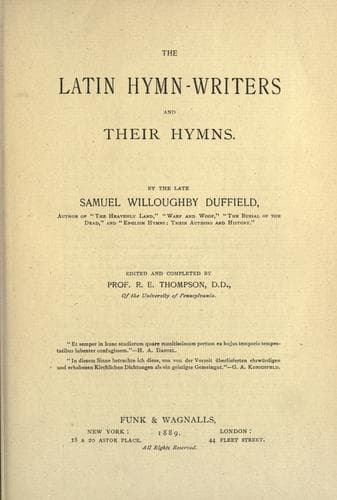
The Latin Hymn-writers and Their HymnsDuffield, Samuel Willoughby
Religion
The Latin Hymn-writers and Their Hymns
Duffield, Samuel Willoughby
Hymns, Latin -- History and criticism
“I suppose that is the reason why the small, old-fashioned book, for
which you need pay only sixpence at a book-stall, works miracles to this
day, turning bitter waters into sweetness, while expensive sermons and
treatises, newly issued, leave all things as they were before. It was
written down by a hand that waited for the heart’s prompting; it is the
chronicle of a solitary hidden anguish, struggle, trust, and triumph—not
written on velvet cushions to teach endurance to those who are treading
with bleeding feet on the stones. And so it remains to all time a
lasting record of human needs and consolations; the voice of a brother
who, ages ago, felt and suffered and renounced, in the cloister,
perhaps, with serge gown and tonsured head, with much chanting and long
fasts, and with a fashion of speech different from ours, but under the
same silent, far-off heavens, and with the same passionate desires, and
with the same strivings, the same failures, the same weariness.”—_The
Mill on the Floss, Book IV., chap._ 3.
All true; but less than the truth; for Thomas’s power lies not in these
negations, but in his personal relation to “the supreme, invisible
Teacher, the pattern of sorrow, the source of all strength,” from whom
Marian Evans turned away to fill up her life with “yearnings and
strivings and failures,” while her only comfort was in the consideration
that she had stilled her pain by no “false anodynes.”
It is a little uncertain at what time the _Imitation_ was written. It
seems not improbable that it was begun in Thomas’s youth, when he had
assumed or was about to assume the responsibilities of the priesthood. A
lofty regard for the sanctity of that office was one of the traditions
of the brotherhood. Groote himself, in view of the stains of his earlier
life, never would assume it, although his ordination would have enabled
him to resume his work of preaching through the Archdiocese of Utrecht.
He never was more than deacon, and the order which silenced him merely
forbade deacons to preach without especial permission. It is not
impossible that in the case of Thomas, as in that of Luther, the
responsibility seemed greater than he could bear, and that it drove him
into a closer and more consecrated fellowship with his Master, which
bore fruit in the first book of this wonderful manual. He was ordained
priest in 1414; there seems good reason to believe that this first
book—the _Imitation_ proper—was known and read at Windesheim, and even
translated into Dutch by Jan Scutken, as early as the year 1420; and
that the other three were written, each as an independent work, before
1425, and then united as one manual of devotion.[17] The oldest
manuscript of the Latin still in existence bears the date 1425, and
testifies to his authorship. The oldest in Thomas’s own handwriting was
made in 1441, and forms part of a series of his works, which he then
collected probably for the first time.
Public-domain text, read in full here on John Shaqi.
Reviews
Reviews
No reviews yet
Be the first to share your thoughts on this work.
Elsewhere in the archive
Join the Discussion
Join the discussion
Sign in to leave a comment or review.
Sign InorCreate an account