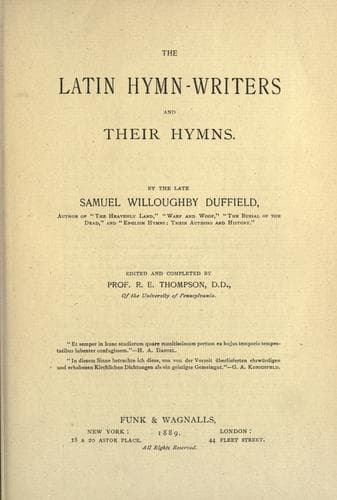
The Latin Hymn-writers and Their HymnsDuffield, Samuel Willoughby
Religion
The Latin Hymn-writers and Their Hymns
Duffield, Samuel Willoughby
Hymns, Latin -- History and criticism
Dr. Trench well says that the whole of our author’s poetry will not
yield a second passage at all to be compared in beauty with this.
Indeed, most of Thomas’s poetry lacks the inspiration which
characterizes his best prose. He is a poet in prose and a prosy poet,
and writes in verse because he has been required to fill up some empty
place in the hymn-list of his monastery. His acquaintance with the
hymn-writer’s art is bounded by his daily familiarity with the hymns of
his breviary, and he betrays the fact by starting from the first lines
of well-known hymns in his own work. But in this hymn on the joys of
heaven he for once struck the right key, although even here he shows
some stiffness of the joints, like a monk more used to a seat in the
Scriptorium than to the saddle of Pegasus. The hymn is known to English
readers by the admirable version of Mrs. Charles:
“High the angel choirs are raising
Heart and voice in harmony.”
CHAPTER XXVII.
FRANCIS XAVIER, MISSIONARY TO THE INDIES (1506-52).
No man, since the days of the Apostles, has been more commended for his
zeal than Xavier. He has been the moon of that “Society of Jesus” of
which Ignatius Loyola was the guiding sun. His privations, heroism, and
success have been the constant theme of the Roman Catholic Church. And
it is impossible to study his life without a conviction that there was
in it a devout and gallant purpose to bless the world.
Our limits and our line of thought alike demand of us that we shall not
attempt, in any exhaustive form, to treat of Francis Xavier from the
theologic or controversial side. He interests us, apart from his
personal character, simply because two Latin hymns have been accredited
to his pen. These have the same opening line,
“_O Deus ego amo Te_,”
but, after this exordium, they proceed quite differently. The second of
them, as we find it placed in Daniel’s collection, has received the
greatest share of esteem, and is known to the entire world of
English-speaking Christians by the admirable translation of Mr. Caswall:
“My God, I love thee, not because
I seek for heaven thereby,” etc.
There is good reason to discredit its authorship, if this be a question
of accuracy with us. Schlosser’s language (Vol. i., p. 407) would
indicate that he regarded it as “generally conceded” to be the
“love-sigh [_Liebesseufzer_] of the holy Francis Xavier.” But no proof
has yet been offered which positively identifies this hymn with its
reputed composer. Its spirit—and that of its companion lyric—is
precisely his own. But so, it may be added, is the spirit of that
touching poem,
“I am old and blind—
Men point to me as stricken by God’s frown,”
Public-domain text, read in full here on John Shaqi.
Reviews
Reviews
No reviews yet
Be the first to share your thoughts on this work.
Elsewhere in the archive
Join the Discussion
Join the discussion
Sign in to leave a comment or review.
Sign InorCreate an account