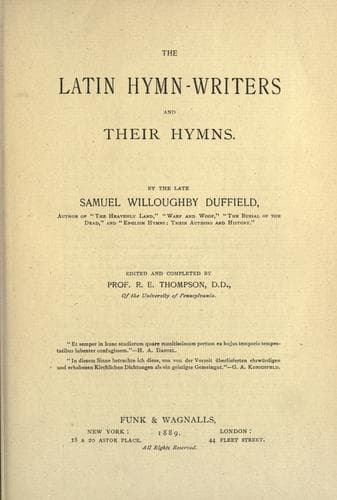
The Latin Hymn-writers and Their HymnsDuffield, Samuel Willoughby
Religion
The Latin Hymn-writers and Their Hymns
Duffield, Samuel Willoughby
Hymns, Latin -- History and criticism
the same as that of John Milton, its once reputed author. No true
student of Milton’s times or of Milton’s language was ever deceived by
it; and the innocent and amiable Quaker lady of our own century, who
wrote it, was perfectly guileless in this impersonation of his grief.
But, nevertheless, it passed current for a long time on the strength of
some one’s literary sagacity.
This species of argument is a very common inheritance to the editors of
Latin hymns, from Thomasius and Clichtove downward. But it is quite as
unsafe as to assign
“I am dying, Egypt, dying,”
to the actual Mark Antony when we know it to have been written by
William Henry Lytle, an American, born in 1829 and dying in 1863.
Therefore, it is scarcely proper authoritatively to accredit these hymns
to Xavier, or, indeed, to any other poet. The utmost that we can say for
them is that no one can prove the converse of the proposition, and that
their style and form are appropriate to the period at which he lived. He
is not known to have written other verses. These may have been the only
exudations of that bruised and wounded spirit which have hardened into
amber and thus have become precious to us. And we would prefer to
believe that he truly appears in these lines in such an exquisite mystic
apotheosis rather than to intermeddle with lower questions, and so,
perhaps, prevent any discussion of himself in these pages at all.
We have been prohibited by much the same destructive analysis from
treating of Augustine, who never wrote a hymn, and to whom the _Ad
perennis vitae fontem_ has been wrongly ascribed, for we know it now to
be the undoubted composition of St. Peter Damiani. In this and in other
similar cases where there is any literary question concerned, it may be
worth our while to investigate with great carefulness. As a rule,
however, the internal evidence offered in the hymns themselves will set
us on the true path. They range in structure from the lowest _corundum_
up to the choicest diamond, and are as various as any gems in their
prosodic form and spiritual color. Like these gems, also, they are
notable for varieties of crystallization—the Dark Ages showing imperfect
angles and crude attempts, and the Renaissance exhibiting again the old
sharp-cut classicism of a time anterior even to Hilary and Ambrose.
Public-domain text, read in full here on John Shaqi.
Reviews
Reviews
No reviews yet
Be the first to share your thoughts on this work.
Elsewhere in the archive
Join the Discussion
Join the discussion
Sign in to leave a comment or review.
Sign InorCreate an account