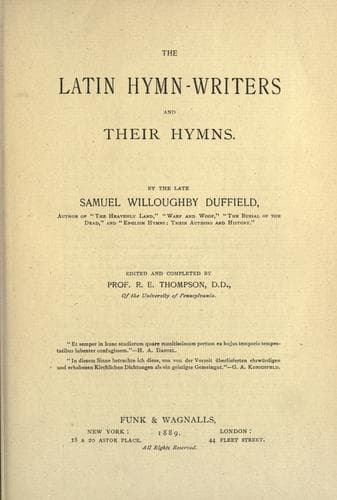
The Latin Hymn-writers and Their HymnsDuffield, Samuel Willoughby
Religion
The Latin Hymn-writers and Their Hymns
Duffield, Samuel Willoughby
Hymns, Latin -- History and criticism
From the higher critical standpoint, then, these hymns are not
unacceptable as Xavier’s own work. They _feel_ as if they belonged to
his age and to his life. They are transfused and shot through by a
personal sense of absorption into the divine love, which has fused and
crystallized them in its fiercest heat. It is proper to inquire,
moreover, if Xavier did _not_ write them, who _did_? Their author must
have been as much superior to his own circumstances and surroundings as
Xavier was to his; and he must also have been as much possessed by this
same holy zeal. It is absolutely incredible that, with these qualities
given, he should not have been known to us in other relations, and,
sooner or later, identified as the true source of their being. The
sixteenth century was a time when literary knowledge was closer and
keener than it had been in the twelfth, and a hymn of that period could
not be attributed to Heloise without exposing its own fallacy; for in
the _Requiescat a labore_ we have such a comparatively modern lyric,
which Daniel rightly tests and finds wanting. “It seems to me,” he says,
“that this song is the production of a later age.” And he might well say
it, for its crystallization, so to speak, is too accurate, too
many-sided, for it to belong in the twelfth century and to the sad
Abbess of the Paraclete.
One cannot, however, declare this so positively of Xavier’s two hymns.
In style and composition the first is inferior to the second; but both
have a simplicity and directness of utterance which may easily secure
that pardon which their rhythm is faulty enough to require. If one were
to assign any special date to them, it would naturally be in the
neighborhood of that pathetic little petition which comes from the
prayer-book of Mary Queen of Scots. The _Domine Deus, speravi in Te_ is
pitched in the same key with these. And as Mary lived from 1542 to 1587,
and Xavier from 1506 to 1552, there is certainly room for these two
compositions to have been prepared by another hand, in the days of
enthusiasm over his triumphant successes and of sorrow over his early
death.
With these arguments for and against the authenticity of the hymns, we
must rest content. Bartoli and Maffei, in their Life of Xavier, are
silent upon the subject; and the careful Königsfeld enters the better
hymn in his collection as anonymous. If we retain the reputed authorship
ourselves, it must be, therefore, rather as Christians than as scholars.
Public-domain text, read in full here on John Shaqi.
Reviews
Reviews
No reviews yet
Be the first to share your thoughts on this work.
Elsewhere in the archive
Join the Discussion
Join the discussion
Sign in to leave a comment or review.
Sign InorCreate an account