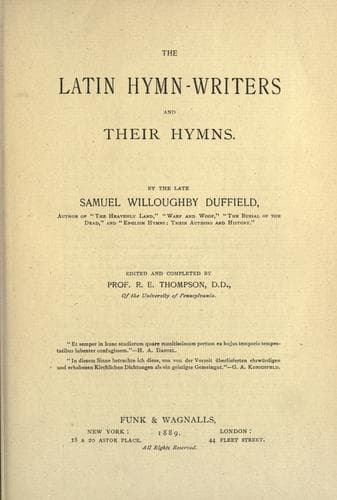
The Latin Hymn-writers and Their HymnsDuffield, Samuel Willoughby
Religion
The Latin Hymn-writers and Their Hymns
Duffield, Samuel Willoughby
Hymns, Latin -- History and criticism
But, having done so, we are entitled to speak of Francis Xavier, and of
his life and his work. The date of his birth is apparently fixed by a
manuscript note in Spanish in a family record possessed by the Xaviers,
which places it upon April 7th, 1506. His father was Don John Giasso, a
man of legal acquirements and of good social position. He was at one
time auditor of the royal council under King John III. For a wife he
chose Donna Maria d’Azpilqueta y Xavier, and the child Francis was born
at the castle of Xavier, a few miles distant from Pampeluna in Navarre,
on the southern slope of the Pyrenees. He was the youngest of a large
family, and the castle where he saw the light gave to him the patronymic
by which he is always known. The family were originally called Asuarez,
but altered their name to Xavier when King Theobald gave them this
property. The mother’s title was thus perpetuated in one of her sons,
but there seems to be some confusion still remaining, for a brother of
the missionary was Captain John Azpilqueta, who also apparently had
exchanged his father’s name of Giasso for one of the designations borne
by his mother.
The biographies of Francis Xavier are naturally of a kind to excite the
critical instincts of a scholar. They are, from the original life by
Torsellini, to the latest Jesuit compilation, remarkable for their
enthusiasm and unlimited credulity. It is only in such calmer treatises
as those of Nicolini, Stephen, Venn, and others, that we get the more
just conception of his character. But to be entirely fair to him we
should take him from the picture painted by his co-religionists,
refusing only those things which are manifestly incongruous or absurd.
The work of Bartoli and Maffei may, for example, be regarded as entirely
safe in its general statements.
From the portraits left to us and preserved in the pages of Nicolini and
Mrs. Jameson, we derive a vivid impression of the man’s personal
intensity. His eyes are deep and thoughtful; his nose strong, rather
blunt, and withal sagacious; and his face is that of a mystic. He is
usually represented as gazing upward in religious rapture and his lips
are parted. His features are more rugged and forcible than refined. They
indicate a rude strength of body and of will rather than a delicate and
sensitive nature. Should we have met him personally, he would have given
us the impression of an enthusiast, deeply affectionate and profoundly
loyal to anything like a military organization. These opinions would
have been approved by the fact.
Public-domain text, read in full here on John Shaqi.
Reviews
Reviews
No reviews yet
Be the first to share your thoughts on this work.
Elsewhere in the archive
Join the Discussion
Join the discussion
Sign in to leave a comment or review.
Sign InorCreate an account