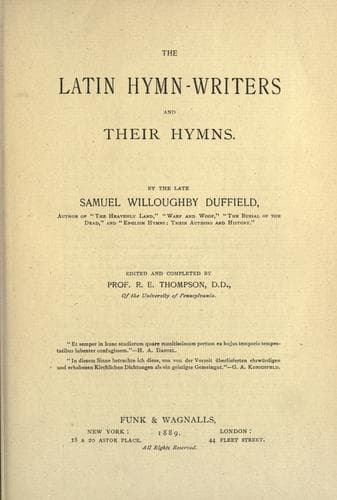
The Latin Hymn-writers and Their HymnsDuffield, Samuel Willoughby
Religion
The Latin Hymn-writers and Their Hymns
Duffield, Samuel Willoughby
Hymns, Latin -- History and criticism
We read that his parents desired to educate him as a cavalier, and that
he was at first instructed at home in the usual topics. But as he showed
zeal and intelligence he was sent, in his eighteenth year, to the
College of Ste. Barbe at Paris. Here he completed the study of
philosophy, received the degree of Master, and began to give instruction
to others. His most intimate friend was Peter Faber, afterward to become
one of the earliest adherents of Ignatius Loyola. And the biographers
are unwearied in their eulogy of Xavier’s and Faber’s purity of life and
morals in the midst of the great temptations of a corrupt city.
To these two young men, ardent of mind and eager in their ambition, now
enters the influence which shapes their destiny. Faber was a Savoyard,
poor and of humble birth, while Xavier was well-to-do and possessed the
haughty spirit of a Spanish grandee. They were, however, kindling each
other up to some scheme of future glory when Ignatius Loyola made his
way to Paris. He had been converted a few years before this and had
already begun to gather proselytes to his opinions. His purpose in
visiting Paris was not merely to avail himself of better facilities for
study, but also to secure more followers. It is not strange to us that
Loyola, with his great sagacity, should have singled out the two
companions and have set himself to win them. Faber’s allegiance, indeed,
it was an easy matter to obtain. But Xavier did not so readily fall in
with the wishes of the great general of the Jesuits.
Faber’s conversion was rapidly accomplished. He was supplied with the
_Spiritual Exercises_, which is, of all books, the best adapted to
produce the proper self-abandonment and plastic condition of soul which
befit the neophyte of the Society of Jesus. And this work, composed, say
the Roman Catholic authorities, in the cavern of Manresa with the help
of the Virgin Mary, may be regarded as the keenest instrument by which
men’s lives were ever carved into the patterns designed by a superior
will. We have no space for a discussion of Jesuitism further than to
indicate its methods when they affect the subject before us, but Faber’s
behavior undoubtedly had its weight upon Xavier. The Savoyard took to
fasting with a perfect fury. In his debilitated condition he was the fit
vehicle for spiritual impressions, for ecstasies, and for mystical
dreams. He would kneel in the open court in the snow, and sometimes
allow himself to be covered with icicles. His bundle of fuel he made
into a bed and slept upon it for the few hours of what one biography
“scarcely knows whether to call torture or repose.” In fact, he so
outran the instruction of Loyola, that that keen observer checked him
and prevented what would have reacted against his own designs. “For,”
saith quaint Matthew Henry, speaking of another subject, “there is a
great deal of doing which, by overdoing, is altogether undone.”
Public-domain text, read in full here on John Shaqi.
Reviews
Reviews
No reviews yet
Be the first to share your thoughts on this work.
Elsewhere in the archive
Join the Discussion
Join the discussion
Sign in to leave a comment or review.
Sign InorCreate an account