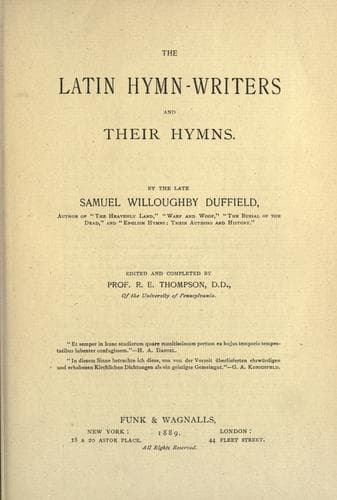
The Latin Hymn-writers and Their HymnsDuffield, Samuel Willoughby
Religion
The Latin Hymn-writers and Their Hymns
Duffield, Samuel Willoughby
Hymns, Latin -- History and criticism
Xavier was, however, more important to Loyola than Faber. And Xavier was
of tougher material and harder to reach. Upon him the intense Loyola
bent the blow-pipe flame of his own spirit. He had failed to touch him
by texts or by austerities. He therefore changed his tactics altogether
and began to soften him by praise, by judicious cultivation of his
sympathies, by procuring new scholars for him, and even by attending his
lectures and feigning a deep interest in whatever he did. In short, he
applied flattery and deference in such a way that he insinuated himself
very soon into the confidence of Xavier, and allowed the haughty Don to
recognize the high birth and good breeding which he could also claim.
This was a master stroke. Faber was after all only a Savoyard; but
Loyola was born in a castle, had been a page at the court of Ferdinand,
and had led soldiers into the deadliest places of battle. He had also
the advantage of being Xavier’s senior by fully fourteen years, for his
birth had been contemporaneous with Columbus’s expedition in search of
the new world.
Here, then, the influence of this strong, undaunted, unflinching spirit
began to focus itself upon the young teacher of philosophy. “Resistance
to praise,” says the bitter La Rochefoucauld, “is a desire to be praised
twice.” And to so acute a student of human nature as Loyola it soon grew
evident that he was making progress. This was proved even by the modesty
of Xavier. Therefore he redoubled his energies and utilized that
marvellous power of adaptation, which was his chief legacy to his order,
in obtaining a definite result. He gained ground so fast that Michael
Navarro, a faithful servant of the young scholar, became determined to
break off this dangerous fascination, and even attempted to kill Loyola
in his private apartments. But he, too, was dealing with a brain which
never relaxed its vigilance and with a magnetic personality which felt a
danger, and moved safely, cat-like, through the dark. He was halted and
challenged by the man he came to kill, and being crushed down in
confusion was thereupon treated with magnanimity, and went away
revolving many things in his mind.
Public-domain text, read in full here on John Shaqi.
Reviews
Reviews
No reviews yet
Be the first to share your thoughts on this work.
Elsewhere in the archive
Join the Discussion
Join the discussion
Sign in to leave a comment or review.
Sign InorCreate an account