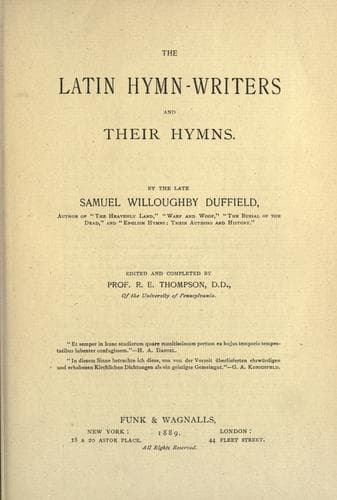
The Latin Hymn-writers and Their HymnsDuffield, Samuel Willoughby
Religion
The Latin Hymn-writers and Their Hymns
Duffield, Samuel Willoughby
Hymns, Latin -- History and criticism
This was the power of Loyola—a power which sprang, first of all, from
his peculiar constitution, and, second, from his fanatical ambition. It
has been the key by which the Jesuit has ever since unlocked the doors
of palaces and contrived to whisper in the ears of kings. Its extent has
been that of the civilized and uncivilized world. In the matter of
organization no human fraternity has ever equalled the Society of Jesus.
The germs which we behold at Ste. Barbe in Paris have grown into a tree
whose roots have taken hold on every soil, and whose fruit has dropped
in every clime. The order has invariably employed strategy, intrigue,
ingenuity, and perfect combination to secure its ends. It is, as a
system, far from being either dead or insignificant. And its real
vitality has always sprung from its maxim that its associated members,
vowed to celibacy and to the accomplishment of its purposes, should be
_Perinde ac si cadavera_—absolutely subordinate and dead to any other
will—in the hands of the “general” who is at the head of its affairs. It
has worked, first for itself, second for the Roman Catholic Church, and
third for the proselytizing of the heathen and the heretics. It has
never neglected to procure in every manner the information it needed to
the full extent or to employ its principle that the end to be gained
justifies the means that are taken to gain it. Thus it is the legitimate
outgrowth of the soldier-courtier-fanatic mind of its founder. And this
was the mind which was now spending its splendid resources upon Xavier,
playing with him like a trout upon the hook, until it should land him, a
completely surrendered man, within its own control.
In another sphere and under other influences, Xavier might have been a
far different person. He, at least, was sincere in his devotion to the
cause. He identified Jesuitism with Christianity and Loyola with Jesus
Himself. Hence his character and labors have blinded many persons to the
methods which he used and to the results which he sought.
It must be sufficient for us that Ignatius Loyola had now gotten the
mastery of Francis Xavier so perfectly that he could be “applied to the
_Spiritual Exercises_, the furnace in which he [Loyola] was accustomed
to refine and purify his chosen vessels.” A sister of the future
missionary had become one of the Barefooted Clares, and had aided in
dissuading her father from interference. And now we behold Xavier
praying with hands and feet tightly bound by cords; or journeying with
similar cords about his arms and the calves of his legs until
inflammation and ulceration ensued. There were now nine of these
converts, but this man outdid the others in his austerities, and finally
travelled on foot with them to meet Loyola at Venice in 1537. The
society had really been formed on August 15th, 1534, at Montmartre near
Paris, and this was but its natural outward movement.
Public-domain text, read in full here on John Shaqi.
Reviews
Reviews
No reviews yet
Be the first to share your thoughts on this work.
Elsewhere in the archive
Join the Discussion
Join the discussion
Sign in to leave a comment or review.
Sign InorCreate an account