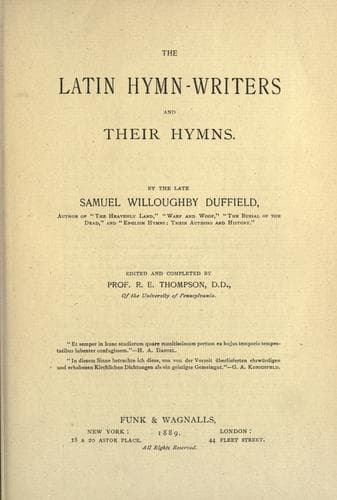
The Latin Hymn-writers and Their HymnsDuffield, Samuel Willoughby
Religion
The Latin Hymn-writers and Their Hymns
Duffield, Samuel Willoughby
Hymns, Latin -- History and criticism
At Venice, on January 8th, 1537, they again met their leader and were
assigned for duty to the two hospitals of the city. That of the
“Incurables” fell to Xavier’s share, and we read that with the morbid
devotion characteristic of a devout student of the _Exercises_, he
determined now to conquer his natural repugnance to disease. In the
course of his duties he had an unusually hideous ulcer to dress for one
of the patients. And the authentic history relates that “encouraging
himself to the utmost, he stooped down, kissed the pestilent cancer,
licked it several times with his tongue, and finally sucked out the
virulent matter to the last drop.” (Bartoli and Maffei, p. 35.) There
could be nothing worse than that certainly. And a man who had resolutely
sounded this deepest abyss of self-abandonment was marked for the
highest honor that the new society could bestow. We cannot doubt
Xavier’s sincerity, but the gigantic horror of this performance is of a
sort to place the man who has achieved it upon an eminence apart from
less daring minds. It was Loyola’s way of facing human nature and
forcing it to concede the supreme self-devotion of his followers. The
world looks with amazement upon such actions, but when it sees them, it
yields a kind of stupefied allegiance to those who have thus rushed
beyond the bounds. And to a close analysis there is as much concealed
spiritual pride about this nastiness as there is an unnecessary shock
given to the sense of decency. Thus, as Mozoomdar says, in his _Oriental
Christ_, “Instead of abasing self, in many cases it serves the opposite
end.” It “imposes a sort of indebtedness upon Heaven” (p. 66). Yet the
poor wretch who felt those lips upon his awful wound could not but
worship the frightful hero who plunged into such nauseous contact with
his loathsomeness.
Yes, this was and is the power of it all. It was and it is the key-note
of much that is potent with the world. When Victor Hugo pictures Jean
Valjean in the toils of the Thenardiers laying that white, hot, hissing
bar of iron upon his arm and calmly standing before them while they
shrink—ogres as they are—from the stench and the sight, he merely uses
this same element. Whatever, in short, among us brings out the old
savage nature; whatever plunges outside of the conventionalities, the
proprieties, or even the common decencies of life; whatever defies the
lightning, or dares the volcano, or tramples upon the coiled serpent,
that is the thing which controls the world.
Public-domain text, read in full here on John Shaqi.
Reviews
Reviews
No reviews yet
Be the first to share your thoughts on this work.
Elsewhere in the archive
Join the Discussion
Join the discussion
Sign in to leave a comment or review.
Sign InorCreate an account