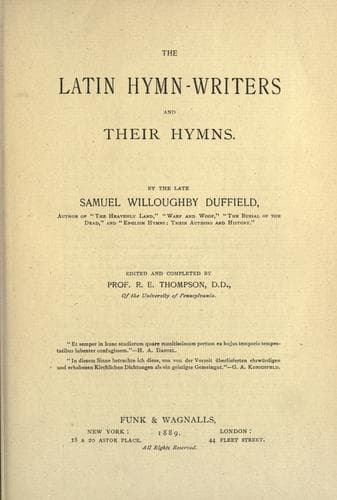
The Latin Hymn-writers and Their HymnsDuffield, Samuel Willoughby
Religion
The Latin Hymn-writers and Their Hymns
Duffield, Samuel Willoughby
Hymns, Latin -- History and criticism
III.
WHITSUNDAY HYMN.
1. What blessed joys are ours,
When time renews our thought
Of that true Comforter
On the disciples brought.
2. With light of quivering flame
In fiery tongues He fell,
And hearts were warm with love
And lips were quick to tell.
3. All tongues were loosened then,
And fear, in men, awoke
Before that mighty power
By which the Spirit spoke.
4. Achieved in mystic sign
Has been that paschal feast,
Whose sacred list of days
The soul from sin released.
5. Thee then, O holiest Lord,
We pray in humble guise
To give such heavenly gifts
Before our later eyes.
6. Fill consecrated breasts
With grace to keep Thy ways;
Show us forgiveness now,
And grant us quiet days.
IV.
HYMNUS MATUTINUS.
1. Jam meta noctis transiit,
Somni quies jam praeterit
Aurora surgit fulgida
Et spargit coelum lux nova.
2. Sed cum diei spiculum
Cernamus, hinc nos omnium
Ad te, superne Lucifer,
Preces necesse est fundere.
3. Te lucis sancte Spiritus
Et caritatis actibus
Ad instar illud gloriae
Nos innovatos effice.
4. Praesta Pater piissime
Patrique compar unice,
Cum Spiritu paraclito
Nunc et per omne saeculum.
IV.
A MORNING HYMN.
1. The limit of the night is passed,
The quiet hour of sleep has fled;
Far up the lance of dawn is cast;
New light upon the heaven is spread.
2. But when this sparkle of the day
Our eyes discern, then, Lord of light,
To Thee our souls make haste to pray
And offer all their wants aright.
3. O Holy Spirit, by the deeds
Of Thine own light and charity,
Renew us through our earthly needs
And cause us to be like to Thee.
4. Grant this, O Father ever blessed;
And Holy Son, our heavenly friend;
And Holy Ghost, Thou comfort best!
Now and until all time shall end.
CHAPTER IV.
POPE DAMASUS AND THE BEGINNING OF RHYME.
Contemporary with Hilary of Poitiers, but probably a younger man, as he
survived him by seventeen years, was Damasus of Rome. Like many other
Romans of the imperial period, he was a Spaniard by birth; or, at least,
he was the son of a Spaniard who had removed to Rome and had become a
deacon or presbyter of the church dedicated to the memory of the Roman
martyr, St. Lawrence. Of his own earlier life we know very little. An
extant epitaph records the fact that he had a sister who became a nun
and died in her twentieth year. He himself served in the Church of St.
Lawrence until his sixtieth year, when he was chosen Bishop of Rome; and
in the accepted catalogue, which begins with the Apostle Peter, he ranks
as the thirty-sixth bishop of the see.
Public-domain text, read in full here on John Shaqi.
Reviews
Reviews
No reviews yet
Be the first to share your thoughts on this work.
Join the Discussion
Join the discussion
Sign in to leave a comment or review.
Sign InorCreate an account