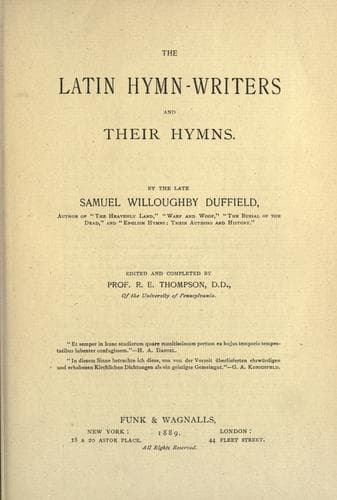
The Latin Hymn-writers and Their HymnsDuffield, Samuel Willoughby
Religion
The Latin Hymn-writers and Their Hymns
Duffield, Samuel Willoughby
Hymns, Latin -- History and criticism
He was chosen bishop in A.D. 366, because of the position he had taken
with reference to the controversy which then agitated the diocese, and
because of the firmness and weight of character he had displayed in the
troubles of the years before his election. The great Christological
controversy was agitating the Church of both East and West. The West was
substantially in agreement with Athanasius, against both the Arians and
the semi-Arians, and would have been entirely so but for the influence
exerted by semi-Arian or Arian emperors and the courtly bishops of their
party. Constantius, the last surviving son of Constantine the Great, was
exceedingly zealous for the semi-Arian doctrine, which rejected the
statement of our Lord’s substantial identity with His Father, but was
willing to assert His substantial likeness. It was only the difference
of an iota in a Greek word—ὁµοουσιος or ὁµοιουσιος—but if there ever was
a case in which neither jot nor tittle must be allowed to pass away, it
was this.
Liberius, who was elected Bishop of Rome in 352, was the victim of
Constantius’s policy. In 353 the East and West were united under his
rule, and that year at Arles, as in 355 at Milan, councils were called,
in which the condemnation of Athanasius was procured by imperial
blandishments. In the former the presbyter sent by Liberius to represent
the Roman see subscribed with the majority. But in the second his three
representatives obeyed their instructions, and accepted disfavor and
exile rather than subscribe. Then Liberius himself was summoned to
Milan, and the weight of imperial threats and persuasions was brought to
bear upon him. He withstood both manfully, and demanded as a preliminary
to any discussion of the charges against Athanasius, that the Nicene
Creed should be subscribed by all parties, and the banished bishops
returned to their sees. When given his choice between submission and
exile, he chose the latter.
The Emperor now sought among the Roman clergy for a man to put into
Liberius’s place. In Rome, as in most of the cities of the West, Arians
were not to be found. But in the Deacon Felix the court party obtained a
candidate who, while himself a Trinitarian, was willing to hold
communion with the Arians, and presumably to condemn Athanasius. Of the
details of his election and ordination little is known, but we find him
installed in the Roman see with the vigorous support of the civil
authority, although not with the assent of the Roman people. The great
body of the Christians in Rome are said to have refused communion with
him because he was tainted by communion with heretics; and when
Constantius came to visit the city, he was besieged by the Christian
ladies of the city with appeals for the restoration of Liberius.
Public-domain text, read in full here on John Shaqi.
Reviews
Reviews
No reviews yet
Be the first to share your thoughts on this work.
Join the Discussion
Join the discussion
Sign in to leave a comment or review.
Sign InorCreate an account