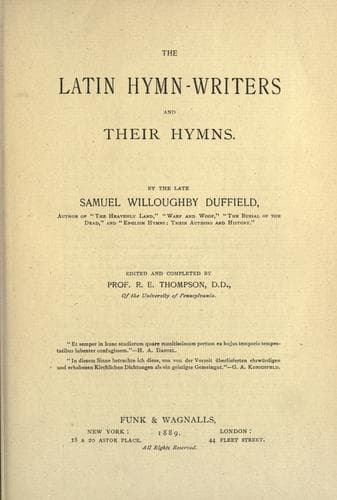
The Latin Hymn-writers and Their HymnsDuffield, Samuel Willoughby
Religion
The Latin Hymn-writers and Their Hymns
Duffield, Samuel Willoughby
Hymns, Latin -- History and criticism
There is another side of Ambrose, and one on which Protestants will love
to dwell. While his great disciple Augustine lent the weight of his
authority to the doctrine that civil constraint might be used to bring
men to orthodox beliefs, Ambrose always denounced that. When Valentinian
II. sent him to Trier to negotiate with the rebel Maximus, in the winter
of 383-84, Ambrose—like his contemporary, Martin of Tours—refused to
have any communion with the bishops who recognized Maximus as Emperor,
not on political grounds, but because they had obtained the execution of
certain Spanish Priscillianists for heresy. This was the first
blood-stain on the white garments of the Church—the first in the long
line of such sins against the Word and Spirit of Christ. Yet Adrian VI.
appealed to it as a precedent against Luther, and described the usurper
as one of “the ancient and pious emperors.” In this he followed the
example of his infallible predecessor, Leo I., who, in 447, declared
there would be an end of all law, human and divine, if such heretics
were allowed to live!
As an orator and writer, Ambrose’s strength lay in the simple direct
plunge of his sentences, wide and grand and forceful as the launching of
a great bowlder down a mountain path. And Mr. Simcox has noticed that
the words which are used to describe his rhetorical power are almost all
derived from _eloqui_. The other assemblage of expressions, drawn from
_disertus_ and the like, refer to the logical or learned weight of an
argument. But what struck every one in the case of Ambrose was that he
let the truth come mightily, just as he felt and believed it, with a
swing and a vigor which was the outburst of his own majestic soul. It
was this which won his victories. It was this power of sincerity which
made him the counsellor of Theodosius and the instructor of Gratian as
well as the guardian of Valentinian II. It was this unshrinking
forwardness of movement which led him to oppose the rebuilding of the
Jews’ synagogue; they had denied the Lord Jesus—let their house burn!
But a victory more Christian was gained when thirty days of respite were
fixed by his intercession between the sentence and execution of
criminals. And although the defence of “Virginity,” as Ambrose conducted
it, was the mainspring of the conventual idea, and was afterward
vigorously used for that purpose, it is again plain that he advocated
what he believed and what he himself devoutly practised. He shines upon
us, from every angle of vision, as a character most pure, serene, and
brave.
Public-domain text, read in full here on John Shaqi.
Reviews
Reviews
No reviews yet
Be the first to share your thoughts on this work.
Elsewhere in the archive
Join the Discussion
Join the discussion
Sign in to leave a comment or review.
Sign InorCreate an account