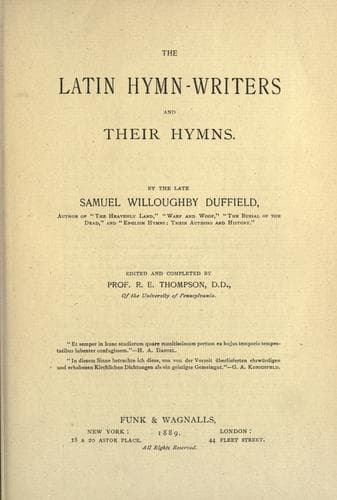
The Latin Hymn-writers and Their HymnsDuffield, Samuel Willoughby
Religion
The Latin Hymn-writers and Their Hymns
Duffield, Samuel Willoughby
Hymns, Latin -- History and criticism
The siege in the basilica at Milan had an important bearing on the whole
future of the Christian Church. Augustine tells us how his mother Monica
had followed him to Milan, and how when there “she hastened the more
eagerly to the church and hung upon the lips of Ambrose.” (_Aug. Conf._,
B. vi.) “That man,” he continues, “she loved as an angel of God because
she knew that by him I had been brought to that doubtful state of faith
I now was in.” She evidently anticipated that so eloquent a preacher
would complete the work that he had been permitted to begin. As for
Augustine himself, he felt “shut out both from his ear and speech by
multitudes of busy people whose weaknesses he served.”
How finely, by the way, this very expression illustrates the greatness
of Ambrose’s character and the unselfishness of his life! We get also a
picture of the man as a student—one whose voice would become worn by any
extended public speaking, and who therefore read to himself in his
private studies in a manner unusual apparently in that age—namely, as we
do now, without opening his lips or articulating the words. The effect
of Justina’s persecution is also given most graphically. (_Aug. Conf._,
B. ix.) For Augustine, having first told us how these heavenly voices
fell upon his ear, says that his mother “bore a chief part of those
anxieties and watchings” and “lived for prayer.” At this date, he
emphatically declares, “it was first instituted that after the manner of
the Eastern churches, hymns and psalms should be sung lest the people
should wax faint through the tediousness of sorrow; and from that day to
this the custom is retained, divers (yea, almost all) congregations
throughout other parts of the world following herein.” It is he,
moreover, who tells us that the two martyrs’ bodies were transferred to
that Ambrosian church erected in 387, and where afterward were placed
the bones of its great founder; which was spared by Barbarossa in 1162,
and which, as the church of San Ambrogio, still occupies its old site in
Milan. Thus we have the most important of contemporary testimony to some
of these troublous scenes.
Public-domain text, read in full here on John Shaqi.
Reviews
Reviews
No reviews yet
Be the first to share your thoughts on this work.
Elsewhere in the archive
Join the Discussion
Join the discussion
Sign in to leave a comment or review.
Sign InorCreate an account