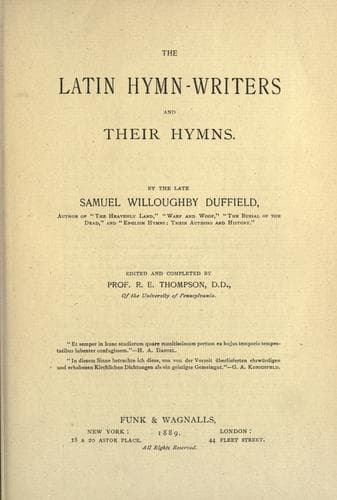
The Latin Hymn-writers and Their HymnsDuffield, Samuel Willoughby
Religion
The Latin Hymn-writers and Their Hymns
Duffield, Samuel Willoughby
Hymns, Latin -- History and criticism
Of the Ambrosian hymns themselves a great deal may be said. It is better
to confine one’s self rather, therefore, to results than to the long
processes which have led thither. But it is impossible to agree with Dr.
Neale and Archbishop Trench, who say of them that “there is a certain
coldness in them—an aloofness of the author from his subject.” This is
one of those bits of critical misapprehension which lead us to doubt the
infallibility of even so admirable a judgment as that of the warden of
Sackville College. The truth is that Dr. Neale admired gorgeousness and
the splendor of ritual. He praises the _Pange lingua_ of Aquinas
altogether too much and he praises Ambrose altogether too little. A
simple and reverent spirit cannot be said to experience, as he does, a
“feeling of disappointment” before this which he calls “an altar of
unhewn stone.” This single phrase exposes the delusion. “_Unhewn_ stone”
is not to Dr. Neale’s nor to Archbishop Trench’s churchly taste, while
it is precisely upon such an altar as that (Ex. 20:25) that God was
ready to let His flame descend. The latest judgment—that of Mr.
Simcox—(_Latin Literature_, vol. ii., 405) is decidedly preferable:
“They all have the character of deep, spontaneous feeling, flowing in a
clear, rhythmical current, and show a more genuine literary feeling than
the prose works.” To any one who is at all familiar with the Ambrosian
hymns this will at once commend itself as the better criticism.
We may pause a moment to inquire about the chants which bear his name,
but we shall have slight enough information. Four tunes are traditional:
the Dorian, Phrygian, Lydian, and Mixed Lydian. What these were and how
they were sung, we do not accurately know. We do know, however, that
Ambrose employed but four notes (the _tetrachord_) where we have
subdivided the various tones into the octave. The Germans do not profess
to tell us anything more definite than this.
The actual hymns are to be reckoned up in several ways. First comes the
mass of _Ambrosiani_, including hymns of Gregory the Great and of other
and much later authors. Many have been foisted into this category
because they were found in old breviaries and manuscripts. Then from
these we may separate the _presumed originals_—of which a large
proportion are now known to belong to other writers. These
misapprehensions are due to such compilers as Fabricius, Cassander,
Clichtove, and Thomasius, who were not invariably correct and who
perpetuated their designations through later works. Still a third class
are the _possible originals_, selected by the judicious but not always
accurate zeal of the Benedictines of St. Maur when they edited the
collected works of the great bishop. And last of all can be placed the
_probable originals_—those hymns which are authenticated by Augustine
and by St. Caelestin (A.D. 430), together with those in structure
closely resembling them.
Public-domain text, read in full here on John Shaqi.
Reviews
Reviews
No reviews yet
Be the first to share your thoughts on this work.
Elsewhere in the archive
Join the Discussion
Join the discussion
Sign in to leave a comment or review.
Sign InorCreate an account