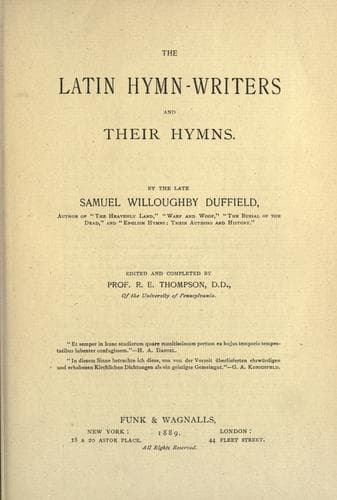
The Latin Hymn-writers and Their HymnsDuffield, Samuel Willoughby
Religion
The Latin Hymn-writers and Their Hymns
Duffield, Samuel Willoughby
Hymns, Latin -- History and criticism
Let us say, then, that he was born in 348, Philippus and Salia being
consuls, at Calahorra, which lies up the Ebro and to the northwest of
Saragossa. To-day Calahorra is a small place of a few thousand
inhabitants, but it furnishes two other notable facts to history in
addition to its claim to be the birthplace of Prudentius. It was this
little fighting town which resisted Afranius, whom Pompey sent to take
it in 78 B.C., and it was then that the citizens ate their wives and
children sooner than surrender. Besides this somewhat doubtful glory it
produced Quinctilian; while Tudela, which is between it and Saragossa,
gave a name to the learned Jew, Benjamin of Tudela, whose ideas about
the Tower of Babel have become as classic as Prudentius’s hymns or as
the Maid of Saragossa herself. It may be added that paganism was very
early abandoned in all this region.
The parents of Prudentius gave him a good education. He possessed, says
Teoli, _ingenium acre, disertum, ferax_—talent that was keen, eloquent,
and fruitful. But at the rhetoricians’ schools, which he attended about
the age of seventeen, he found little that was commendable in manners or
morals. It would appear that he gave the rein to his vices and that his
life was not very rapidly turned into the ways of Christianity.
He was at first called to the bar and made judge in two towns of
considerable size, which may perhaps have been Toledo and Cordova. About
the year 400 he is supposed to have gone to Rome and to have been
favorably received by Honorius the Emperor, who then promoted him to
some sort of honorable office in his native country. At fifty-seven
years of age, as he himself tells us, he began to cultivate literature.
He had retired from active life, much as Chaucer did in later days. From
this period onward he lived in quiet; he “fled fro’ the presse and dwelt
in soothfastnesse,” like the father of English verse. He gave himself to
sacred things—to hymns in honor of God and of the saints, and to poems
against paganism and in favor of Christian duty.
His poems have Greek titles. First comes the _Psychomachia_ (the Battles
of the Soul)—in hexameter—treating of the conflict in a Christian soul
between virtue and vice. The contrasts are arranged somewhat like those
of Plutarch between the Greek and Roman leaders, only, of course, the
antithesis is decidedly against the vices. Here stand Faith opposed to
Idolatry, and Chastity facing Impurity, and Patience resisting Anger,
and Humility contrasted with Pride, and Sobriety pre-eminent over
Excess, and Liberality vanquishing Covetousness, and Concord healing the
wounds caused by Dissension. There are nine hundred and fifteen lines in
the poem.
Public-domain text, read in full here on John Shaqi.
Reviews
Reviews
No reviews yet
Be the first to share your thoughts on this work.
Elsewhere in the archive
Join the Discussion
Join the discussion
Sign in to leave a comment or review.
Sign InorCreate an account