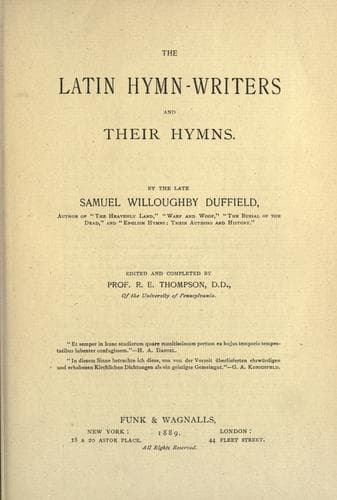
The Latin Hymn-writers and Their HymnsDuffield, Samuel Willoughby
Religion
The Latin Hymn-writers and Their Hymns
Duffield, Samuel Willoughby
Hymns, Latin -- History and criticism
Latin hymnology gives a distinguished place to a hymn of twenty-three
stanzas, each stanza containing four lines and beginning with a letter
of the alphabet in regular order. Thus from A to Z all the letters
appear except J, U, and W. Caterva is spelled Katerva, to answer for K.
Y is represented by _Ymnis_, which is another form of _Hymnis_. And at
last _Zelum_ concludes the list. The author struggles with a difficulty
when he takes _Xeromyrrham_ to answer for X, but otherwise the ideas and
versification are so excellent as to have made the hymn classic. The
Roman Breviary uses two selections from it. One commences _A solis ortus
cardine, ad usque_, and the other, _Hostis Herodes impie_. The general
subject is the Nativity, but the poem soon proceeds to the Miracles of
our Lord, and closes with an ascription of praise for His Resurrection.
There can be no doubt about the authorship. Old manuscript codices, and
the tradition of the Church, assign it definitely to Caelius
Sedulius—sometimes called Caius Caelius Sedulius—who flourished near the
middle of the fifth century. But his personal history is much harder to
come at, and the few facts which we possess only stimulate our curiosity
to know more. And besides, he is so entangled with another Sedulius—also
a poet, also a celebrated author, also a Scot, and also involved in much
obscurity—that nearly every notice of his name contains more or less of
error. This second Sedulius, however, wrote no hymn which has survived,
and therefore needs no further mention. He is always named Sedulius
_Scotus_, to distinguish him from our Sedulius, who is invariably called
_Caelius_ Sedulius. He flourished somewhere between 721 and 818, while
the best ascertained date of his predecessor’s life appears to be 434.
Our sources of information regarding Sedulius are Isidore of Seville and
Fortunatus of Poitiers. Jerome (Hieronymus) left a catalogue of authors
from the time of St. Peter to his own day. This was continued by
Gennadius, as Notker of St. Gall tells us, and then it was still further
extended by Isidore. Neither Jerome nor Gennadius mention our poet; the
first because he died in 420, before Sedulius had achieved distinction,
and the second possibly for the same reason, as his death occurred about
496 at Marseilles. Isidore (who died 636) then undertook to supply the
deficiencies of the catalogue and inserted a brief note respecting
Sedulius.
Earlier than Isidore, however, is Fortunatus (530-609), who names our
author as one of the five first Christian poets. Juvencus he dates at
330 A.D.; Sedulius flourished in the first half of the fifth century;
Prudentius was converted in 405; Paulinus died in 458, and Arator was at
his zenith in 560. This would seem to fix pretty closely the period to
which Sedulius belongs.
Public-domain text, read in full here on John Shaqi.
Reviews
Reviews
No reviews yet
Be the first to share your thoughts on this work.
Elsewhere in the archive
Join the Discussion
Join the discussion
Sign in to leave a comment or review.
Sign InorCreate an account