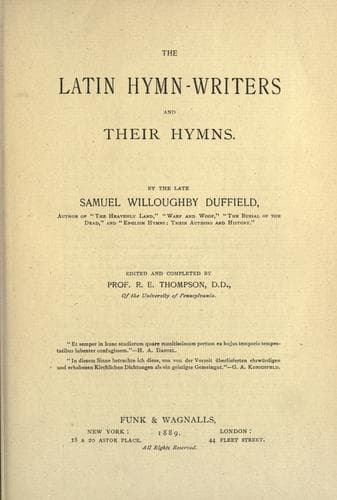
The Latin Hymn-writers and Their HymnsDuffield, Samuel Willoughby
Religion
The Latin Hymn-writers and Their Hymns
Duffield, Samuel Willoughby
Hymns, Latin -- History and criticism
References in the manuscripts are of no additional value. They tell us
that he was a “Gentile layman,” or, in other words, a person not of
Italian birth; that he learned philosophy in Italy; was converted and
baptized by Macedonius, a presbyter; and that he wrote his theological
works in Arcadia, or, as some say, Achaia. The Vatican “Codex of the
Queen of Sweden” calls him a “verse-maker” and “teacher of the art of
heroic metre.” Another codex adds that he also taught other varieties of
metrical composition, and that all this happened in the days of the
younger Theodosius, son of Arcadius, and of Valentinian, son of
Constantine. Of his specific writings still another codex states that he
“put forth in Achaia this book against error and composed in verse a
commendation of the Christian faith.”
Some Sedulius, “notable for his writings,” appears to have found his way
into Spain where, in the year 428, Isicius, a Palestine monk, who had
become Bishop of Toledo, detained him for his good fellowship at Toledo.
With him is said to have tarried a certain Bishop Oretanus, and the
inference is that these three worthies held numerous symposia upon
theology and literature. But the story is denied by Nicolaus Antonius,
the historian of old Spanish scholarship.
Those minute and laborious investigators, the Benedictines, have, with
ant-like patience, threaded every corner of the labyrinth in which these
stray facts are gathered. They assert that Macedonius probably received
him after he had been baptized by some one else. And while we do not
know under what master he studied theology, nor even where the school
was located, we know that Sedulius became presbyter in a church whose
bishop’s name was Ursinus, and where Ursicinus, Laurentius, and
Gallicanus were his co-presbyters.
Ussher relates that the epithet _Scotigena_—the Scot—was frequently
applied to him. Trithemius gives us to understand that he was led by
love of learning to visit France, then Italy, then Asia, and then
Achaia, and that his reputation was gained in the city of Rome. Sixtus
Senensis compares him to Apollonius of Tyana in his zealous pursuit of
wisdom; and enlarges the list of countries which he traversed by adding
Britain and Spain. Under Theodosius and at Rome, he too declares
Sedulius to have been famous in prose and verse. But Ussher first
claimed him for Britain; and Ussher it was who maintained that he was a
pupil of that Hildebert who ranks among the earliest of the Irish
bishops. It must not be forgotten that somewhere in Britain in those
days there was the light of Christianity, for in 432 St. Patrick set out
from Scotland “to convert Ireland.” Nor can we omit to notice that
Ussher styles Sedulius “Scotus Hybernensis,” thus originating the
expression “Scotch-Irishman,” but using it in exactly the reverse of its
modern sense.
Public-domain text, read in full here on John Shaqi.
Reviews
Reviews
No reviews yet
Be the first to share your thoughts on this work.
Elsewhere in the archive
Join the Discussion
Join the discussion
Sign in to leave a comment or review.
Sign InorCreate an account