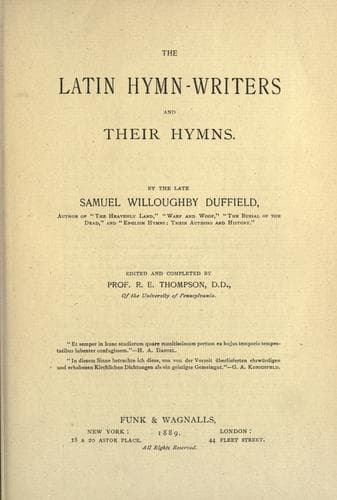
The Latin Hymn-writers and Their HymnsDuffield, Samuel Willoughby
Religion
The Latin Hymn-writers and Their Hymns
Duffield, Samuel Willoughby
Hymns, Latin -- History and criticism
So far as these partial facts and conjectures go we are safe in
affirming that Sedulius was a learned and studious person, probably an
Irishman—for at that time Scot and Irishman were synonymous—and that he
gained renown about the year 434, having studied in Italy, travelled
extensively, and been a resident in Achaia. The temptation is, however,
irresistible to make him Irish rather than Scotch, upon the strength of
the most ancient “bull” on record. It is found in the Alphabet Hymn and
reads thus:
“Quarta die jam foetidus
Vitam recepit Lazarus,
Cunctisque liber vinculis
Factus superstes est sibi.”
“Upon the fourth day Lazarus
Revived, though all malodorous;
And freed from the enchaining ground
Himself his own survivor found!”
The writings of Sedulius are more numerous than might be supposed. Those
which have been preserved are nine, two in verse and the rest in prose.
The most elaborate is a commentary on the four Gospels, dedicated to the
abbot Macedonius and to which he prefixed his _Carmen Paschale_. He also
wrote on the Pauline Epistles, as did his namesake of the ninth century.
To Theodosius he addressed a book. He wrote treatises on the books of
Priscian and Donatus, the grammarians. He also treated of the miracles
of Christ in prose and sent out many “epistles of Sedulius Scotigena.”
His poetry is comprised in the Alphabet Hymn; in the _Carmen Paschale_
whence we get nothing for hymnology except the hexameter _Salve Sancta
Parens enixa_ (_puerpera regem_); and in the Elegy, from which comes the
_Cantemus socii_.
The _Carmen Paschale_ is an epic in the Virgilian style. The Elegy is an
exhortation to the faithful. But the Alphabet Hymn has enriched the
Church with two lyrics, one on the Nativity and one on the Slaughter of
the Innocents. By placing the first stanza side by side with the first
stanza of the famous Ambrosian hymn, it is easily seen that they are the
same.
_Ambrosian._
“A solis ortus cardine
Et usque terrae limitem
Christum canamus principem
Natum Mariae virginis.”
_Sedulian._
“A solis ortus cardine
Ad usque terrae limitem
Christum canamus principem
Natum Maria virgine.”
But this is no unusual occurrence in days when the language of the
Psalms was employed in the Ambrosian hymns, and when the Ambrosian hymns
themselves furnished a convenient foundation for the later praises of
the Church. Not only did Sedulius imitate them closely, but Ennodius,
Fortunatus, Gregory, Bede, Rabanus, and Damiani—with many other unknown
writers—studied and copied their metre and expression. A curious
instance of this same copying and following can be found in our own
hymn. In it the stanza, _Ibant magi quam viderant_, contains two lines
which have been inserted bodily in a production of the fourteenth or
fifteenth century. It is true that they are very suggestive and
beautiful, but when Sedulius wrote
Public-domain text, read in full here on John Shaqi.
Reviews
Reviews
No reviews yet
Be the first to share your thoughts on this work.
Elsewhere in the archive
Join the Discussion
Join the discussion
Sign in to leave a comment or review.
Sign InorCreate an account