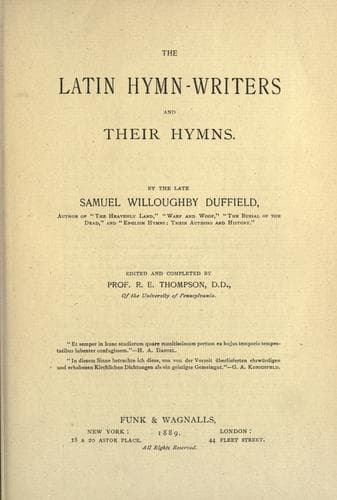
The Latin Hymn-writers and Their HymnsDuffield, Samuel Willoughby
Religion
The Latin Hymn-writers and Their Hymns
Duffield, Samuel Willoughby
Hymns, Latin -- History and criticism
“Stellam sequentes praeviam
Lumen requirunt lumine,”
he wrote what was original with him, but which was sheer theft in the
hands of the author of _Hymnis laudum preconiis_, who nevertheless takes
the couplet to grace the feast of the Three Kings.
Latin hymns are by no means all beautiful or all graceful. The earlier
pieces appear and reappear—fragments from the better workmanship of the
past—throughout the Dark Ages. And here we must leave Sedulius. If he
was indeed the companion of Hildebert, his story belongs to that
fabulous age of the British Church when bishops were but simple pastors
and when great purity and truth prevailed. In the Alphabet Hymn there
are references to the direct Scripture narrative; to the “enclosed John”
who greets the Saviour; to Him fed with a little milk, who Himself feeds
the birds; to the great Shepherd revealed to shepherds; to Herod who
seems to fear a King who does not covet earthly dignities; to the Magi
who seek their Light from the light; to the healing of the sick and the
raising of the dead; to the water that blushes into wine, as perhaps
Crashaw had read; to Peter who fears by nature and walks the wave by
faith; to Lazarus “his own survivor;” to Judas the _carnifex_ who
professed peace by his kiss which was not in his soul; to Him who
triumphing over Tartarus returned of Himself to heaven. Such is the
hymn, and upon reading it one is not surprised that Fortunatus called
its author _Sedulius dulcis_—the sweet Sedulius. Nay, Rudolph of
Dunstable goes so far as to perpetrate a pun, and declares that Sedulius
_sedulously_ sings of things that are old and new. And the dear man of
God, Dr. Martin Luther of blessed memory, who had no relish for
Ambrose’s hymns, called our Irishman a _poeta Christianissimus_, and
translated into his massive German both the hymns the Breviary had
extracted from his chief poem.
CHAPTER IX.
VENANTIUS FORTUNATUS THE TROUBADOUR.
Venantius Honorius Clementianus Fortunatus was a man not satisfied with
four names. In jest or earnest he assumed another, Theodosius. In point
of time he had an interesting position; in regard to residence his story
becomes really valuable; and when we add that he gave to the Church
several of her best-known hymns, he appears before us as a person
unfamiliar, but highly attractive.
Public-domain text, read in full here on John Shaqi.
Reviews
Reviews
No reviews yet
Be the first to share your thoughts on this work.
Elsewhere in the archive
Join the Discussion
Join the discussion
Sign in to leave a comment or review.
Sign InorCreate an account