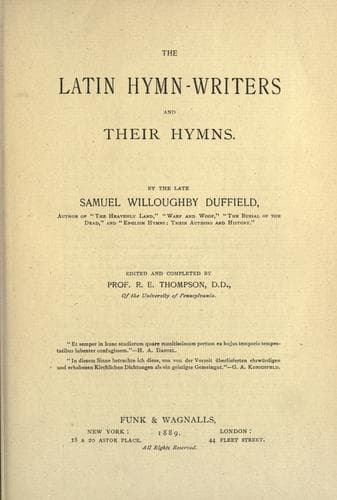
The Latin Hymn-writers and Their HymnsDuffield, Samuel Willoughby
Religion
The Latin Hymn-writers and Their Hymns
Duffield, Samuel Willoughby
Hymns, Latin -- History and criticism
If, as we have reason to think, he came into France in 566 or 567, at
the age of thirty-five or thirty-six, we must suppose him to have been
born about 531. He was an Italian of Treviso, which is not far northwest
of Venice and northeast of Padua. Of his parentage and early education
(except the fact that he was trained at Ravenna) we are ignorant; but he
is said to have been acquainted with Boethius, a thing hard to believe,
for the philosopher perished in 524. We are left in some doubt whether
he had set forth from Italy because the Lombards were about to invade
his part of it, or whether religious motives were at the bottom of this
“exile,” as he is very ready to call it.
Judging his unknown past by his better-known later history, he was a man
of affable and genial character, who could pay for all favors in the
small coin of panegyric, and whose pen filled his pocket and procured
him the hospitality of the rich and the great of the earth. We know he
could sing, for he says so himself; and he could also turn verses so
sweet and mellow that even the poorest of them were learned by his
admirers and recited again with much delight. Now it happened that his
eyes were affected, and his friend Gregory of Tours sent him some of the
blessed St. Martin’s holy lamp-oil. When this was rubbed upon them—and
it was doubtless good oil, and therefore not an objectionable
ointment—he was greatly helped. He consequently showed his gratitude in
two ways: by making a pilgrimage to the blessed St. Martin’s own town,
and by writing the blessed St. Martin’s biography. This last he
accomplished to the extent of four books of verse, employing, without
any apparent scruple, the much more classic and elaborate treatise of
Sulpicius Severus as the groundwork of his own. It was this journey
which raises the question whether he was avoiding the Lombards or
performing a pious vow when he entered France. Perhaps in this, as in
other events of his life, the religious garment covered the secular
desire.
From his native country, then, he made his way into another and less
cultivated region. There was a Gallo-Roman society at the time, very
much as there now are groups of educated persons in Siberia, or in the
seaboard cities of China. A certain freemasonry of intelligence passed a
literary man along from castle to cloister and from cloister to court.
It was a period when classic learning was at its lowest ebb, and when
the Romance tongues, like the second growth of a forest, were thickly
clustering in upon the few survivors of the ancient groves of
literature. The sixth century was removed from the past, but had not
attained to much on its own account.
Public-domain text, read in full here on John Shaqi.
Reviews
Reviews
No reviews yet
Be the first to share your thoughts on this work.
Elsewhere in the archive
Join the Discussion
Join the discussion
Sign in to leave a comment or review.
Sign InorCreate an account