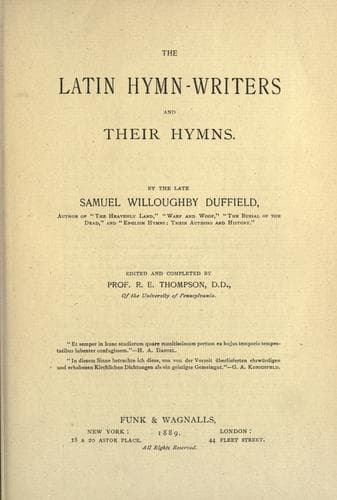
The Latin Hymn-writers and Their HymnsDuffield, Samuel Willoughby
Religion
The Latin Hymn-writers and Their Hymns
Duffield, Samuel Willoughby
Hymns, Latin -- History and criticism
Yet we must not think that this century was barren of beginnings. The
Merving kings—Clovis, and Childebert, and Clotaire the First, and
Charibert—had now given place to Chilperic on the throne of France.
Indeed, some writers are inclined to make this sixth century the true
commencement of the Middle Ages, and it is very certain that we can see
a great deal in the story of Fortunatus which is mediaeval. Moreover,
Mohammed was born in 570, at Mecca, while our future bishop was
traversing Gaul. And nearly contemporary with our author’s birth—that
is, in 533—comes the announcement of the supremacy of the Roman bishop,
which culminated in 590 in the strong administration of Gregory the
Great. Fortunatus lived, therefore, in days when Latin Christianity was
taking shape, and when the most aggressive of false religions was
springing up. We have indeed said, in effect, that the Western Empire
was at an end, and that the Monarchy of France had begun in 476.
Thus, as he looked backward, the Italian refugee could recall the
successive blows of barbarian swords—the swords of Alaric, and Genseric,
and Attila, and Odoacer—under which Rome had fallen. When Alboin started
his raid from Pannonia in 568, with Lombards (Longobardi) and Gepidae
and twenty thousand Saxons, it was surely enough to make a troubadour
take refuge at Tours.
Our materials for the biography of Fortunatus from this point in the
story become more available. He kept an itinerary, which was lost; but
he wrote often to Gregory of Tours, and this seems to be the only
correspondence which he conducted in a natural and ordinary manner. From
it we learn that he crossed the mountains in a “snowy July,” and had
written either “on horseback or half asleep.” He passed some time at
Metz and Rheims. His days and nights were spent in travelling and
feasting and in preparing songs and odes, to the consternation of his
modern biographer, Luchi, who does not find much evidence of piety in
these proceedings.
Fortunatus is his own exponent, and his language, literally translated,
gives us a vivid picture of the way in which he made friends with
everybody. “Travelling among the barbarians” (he writes to Gregory), “on
a long journey, either weary of the way or drunk beneath the icy chill,
at the exhortation of the muse (I know not whether more cold or sober),
a new Orpheus I gave voices to the wood, and the wood replied.” The
sentence illustrates not merely his experience but also his style of
composition, which is turgid and frequently obscure. His panegyrics, for
example, abound in the most fulsome flattery, arrayed bombastically in a
string of nouns, verbs, and adjectives half a page long. The real idea
walks within much of his Latin, like a pigmy in a great court train,
ridiculously small and ridiculously pretentious.
Public-domain text, read in full here on John Shaqi.
Reviews
Reviews
No reviews yet
Be the first to share your thoughts on this work.
Elsewhere in the archive
Join the Discussion
Join the discussion
Sign in to leave a comment or review.
Sign InorCreate an account