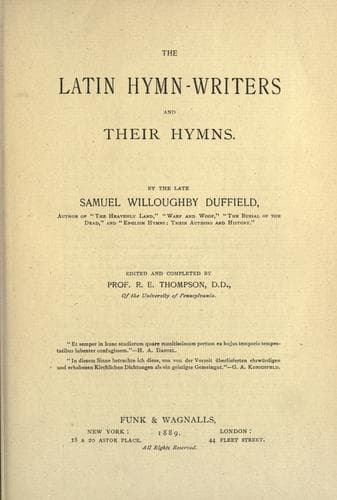
The Latin Hymn-writers and Their HymnsDuffield, Samuel Willoughby
Religion
The Latin Hymn-writers and Their Hymns
Duffield, Samuel Willoughby
Hymns, Latin -- History and criticism
Sometimes these same expressions of our poet betoken a convivial
familiarity with his friend Gregory of Tours, which is not precisely
canonical. Many post-classical words appear, and phrases which no
grammarian would easily justify. The man is full of sly hints of good
eating and drinking, and has a high-flown style of compliment, as when
he writes to Lupus, “As often as I put together the parts of your
discourse, I thought that I reclined upon ambrosial roses.” To Sigismund
and Aregesles, two brothers, he declares that, “This sweet letter
reveals to me the names of friends. Here is the brilliant Sigismund, and
here is the modest Aregesles. After Italy, O Rhine, thou givest me
parents, and by the coming of these brothers I shall be no longer a
stranger.” In fact, he picked up “brothers” and “parents” with charming
facility, and had a dexterity in drawing a corner of the mantle of royal
favor over him which any courtier might covet.
Thus he went—we cannot well detect in what order or by what method, but
pretty conclusively as a troubadour might have done—all through France.
Like Chamisso, he proposed to
“Take his harp in his hand
And wander the wide world over,
Singing from land to land.”
With Sigebert, King of Austrasia, he contracted quite a friendship, and
being at Poitiers when Gelesuintha was put to death, he lamented her in
verses which pleased Sigebert, her brother-in-law and avenger, greatly.
He also became well acquainted with Euphronius of Tours, nephew of St.
Gregory, the bishop, and thus laid a good foundation for ecclesiastical
preferment. But it was to Poitiers that he gradually drifted, and there
circumstances fixed him for the most of his life.
We may safely conclude that Tours, which is not a great distance off,
first attracted his wandering feet. He had a duty to the blessed St.
Martin’s holy lamp and to the blessed St. Martin’s holy memory, and
these devout proceedings were more than sufficient to commend him to a
hospitable bishop. Contemporary accounts of him are lacking, if we
except the brief notice of Paul the Deacon, which cannot properly be
called contemporary, as it is in his history of the Lombards, which was
prepared in the first half of the eighth century. But Fortunatus again
comes to our rescue with quite a goodly supply of verses and with some
epistles which show that the life of that period was a curious resultant
between the Roman and barbarian ideas. It ought in honesty to be added
that Brunehilda was no saint, and that the court of the Merovingians was
so barbaric that it stood by and saw her torn to death, at eighty, at
the heels of a wild horse; and this was later even than Fortunatus’s
day.
Public-domain text, read in full here on John Shaqi.
Reviews
Reviews
No reviews yet
Be the first to share your thoughts on this work.
Elsewhere in the archive
Join the Discussion
Join the discussion
Sign in to leave a comment or review.
Sign InorCreate an account