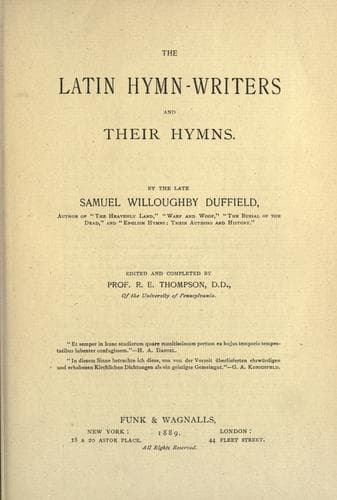
The Latin Hymn-writers and Their HymnsDuffield, Samuel Willoughby
Religion
The Latin Hymn-writers and Their Hymns
Duffield, Samuel Willoughby
Hymns, Latin -- History and criticism
By this time Treviso (Trevisium) had been regularly attacked by the
Lombards, and the pilgrimage, which had changed to a pleasure-trip,
changed again to a residence. He speaks of himself later as having been
“for nine years an exile from Italy,” and his only reference to his
family that is discoverable is when he tells the Abbess Agnes that she
is as dear to him as his own sister Titiana. He is a poet driven like a
leaf before the storm, and he is whirled first into Tours and then into
the safe eddy of Poitiers, which he celebrates reverently in song as the
home of the great Hilary.
His royal friendships are made apparent by _epithalamia_—especially that
on the marriage of Sigebert and Brunehilda—and by various odes. But now
comes the real romance of our poet’s life. Clotaire the First had
married a fair woman named Radegunda, whose piety gave him not a little
trouble. She was determined to keep all her vigils and fasts and to
exert herself in works of charity, even to the scrubbing of the base of
the altar with her own hands. It was one of her greatest pleasures to
take leprous women in her arms and kiss them, and when one of the lepers
said to her, “Who will kiss you after you embrace us?” she “answered
benevolently, that if others will not kiss me, it is truly no affair of
mine.”
It would be beneath the dignity of this narrative, if it were not a
portion of her own life in the Latin, for us to record the incident
which helped to cause her separation from her husband. She had arisen at
night and came back thoroughly chilled, and with her feet properly cold.
Clotaire growled out that he would sooner have a nun for a wife
(_jugalem monacham_) than such a queen. So she took him at his word,
founded a convent at Poitiers, and distinguished herself to later
generations by many noble works.
Over this convent she placed her maid Agnes, and served her former
servant with profound humility and obedience, albeit she must always
have been herself the ruling spirit of the place. With Fortunatus she
formed a close friendship. And as this is the beginning of the
conventual and ecclesiastical side of his career, we may as well bring
the story up to its parallel point in current history.
Public-domain text, read in full here on John Shaqi.
Reviews
Reviews
No reviews yet
Be the first to share your thoughts on this work.
Elsewhere in the archive
Join the Discussion
Join the discussion
Sign in to leave a comment or review.
Sign InorCreate an account