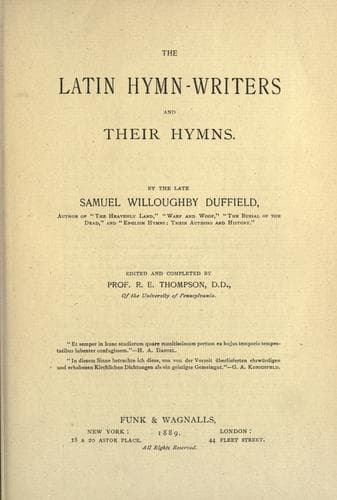
The Latin Hymn-writers and Their HymnsDuffield, Samuel Willoughby
Religion
The Latin Hymn-writers and Their Hymns
Duffield, Samuel Willoughby
Hymns, Latin -- History and criticism
Gregory, Archbishop of Tours and historian of France, always addresses
his friend Fortunatus as _presbyter Italicus_. That Fortunatus embraced
the monastic life at Aquileia (about 558-59) has been maintained, and
the opinion is also fairly defended that he was enrolled as a “cleric”
at Poitiers, although he was _novus_, or a “new-comer,” there. He had
evidently some _quasi_ ecclesiastical connection, and those were days
when the celibacy of the clergy was much mooted, but when the wandering
monks had not yet been held to the stringencies of the monastic orders.
If we ask Fortunatus why he remained in Gaul, he replies that Radegunda
retained him there “by her prayers and vows.” It is conjectural that he
was first chaplain to the convent, and it is certain that then he was
elevated to the rank of Bishop of Poitiers.
To this daughter of Berthar, King of the Thuringi, our troubadour now
paid his devoirs. Often at “the convivial banquets of the barbarians” he
had “poured forth his verses.” He was now to become the devoted cavalier
of a queen and an abbess, and to furnish literature with some very
unique specimens of religio-amatory verse.
The life of Radegunda, written by Fortunatus and amplified by the nun
Bandonivia, furnishes many interesting facts about this holy woman. She
took her final resolution to separate from her husband after he had
unjustly put her brother to death. On this she went to St. Medard and
declared her intention of celibacy, and thence to the church of St.
Martin, at Tours, where she made her formal vows. From this she retired
to her villa called Suedas, near Poitiers, which she turned into a
convent. Thither in 569 the Emperor Justinus (Justin II.) sent rich
presents, one being a portion of the true cross. This inspired
Fortunatus with a new song, and he broke out in the _Vexilla Regis_,
which is surely one of the most stirring strains in our hymnology.
The following version expresses literally and without modification the
ideas set forth in the Latin:
“VEXILLA REGIS PRODEUNT.”
The royal banners forward fly;
The cross upon them cheers the sky;
That cross whereon our Maker hung,
In human form, by anguish wrung.
For he was wounded bitterly
By that dread spear-thrust on the tree,
And there, to set us free from guilt,
His very life in blood he spilt.
Accomplished now is what was told
By David in his psalm of old,
Who saith,[5] “The heathen world shall see
God as their King upon the tree.”
O tree, renowned and shining high,
Thy crimson is a royal dye!
Elect from such a worthy root
To bear those holy limbs, thy fruit.
Blessèd upon whose branches then
Hung the great gift of God to men;
Whose price, of human life and breath,
Redeemed us from the thrall of death.
Thy bark exhales a perfume sweet
With which no nectar may compete;
And, joyful in thine ample fruit,
A noble triumph crowns thy root.
Public-domain text, read in full here on John Shaqi.
Reviews
Reviews
No reviews yet
Be the first to share your thoughts on this work.
Elsewhere in the archive
Join the Discussion
Join the discussion
Sign in to leave a comment or review.
Sign InorCreate an account