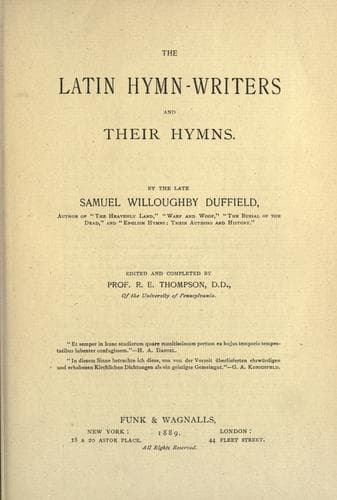
The Latin Hymn-writers and Their HymnsDuffield, Samuel Willoughby
Religion
The Latin Hymn-writers and Their Hymns
Duffield, Samuel Willoughby
Hymns, Latin -- History and criticism
Hail, altar! and thou, Victim, hail!
Thy glorious passion shall not fail;
Whereby our life no death might lack,
And life from death be rendered back.
O Cross, our only hope, all hail!
In this the time when woes assail,
To all the pious grant thy grace,
And all the sinners’ sins efface!
At this time Fortunatus also composed a long poem of thanks to Justin
and Sophia for gifts sent to himself, by which it would appear that he
was tolerably well identified with the interests of Radegunda and her
convent.
From this date onward his friendship with Agnes and Radegunda exposed
both him and them to very considerable comment. He even refers to it in
one of his poems, addressed to the abbess, in which he protests the
purity of his conduct. But it is not hard to see how his expressions
might be misunderstood. They are frequently fervid beyond the courtesies
of compliment, and they remind us all the while of those singers of the
eleventh and twelfth centuries who begin with William, Count of this
very city of Poitiers (1071-1127), and who have made the name of
“troubadour” synonymous with the praise of love and beauty. Fortunatus
calls on Christ, and Peter, and Paul, and Mary to witness the entire
propriety of his love for Agnes and Radegunda, but he follows it with
lines which Bertrand de Born or Alain Chartier might have composed.
Really there is a great deal of this exuberant poetry in the worthy
chaplain. He wrote every sort of odd acrostic on the holy cross,
reminding us in more ways than one of Damasus, or of the later cavalier
poets of England. He tells Radegunda, who seems his principal star, that
everything is alike when he does not see her; that although the sky is
cloudless, yet, if she is absent, “the day stands without a sun.” He
excuses himself in other verses for sending her violets instead of
lilies and roses. Any incident in which Radegunda plays a part is enough
to turn the poetic stream upon the mill-wheel of his verse. If there are
flowers on the altar; if there are flowers sent by her to himself; if
she has retired from the world to perform her vows; if she has returned
again to the public gaze, and especially if he has been at a little
dinner or has received some agreeable little dishes—then the bard
strings his harp!
Public-domain text, read in full here on John Shaqi.
Reviews
Reviews
No reviews yet
Be the first to share your thoughts on this work.
Elsewhere in the archive
Join the Discussion
Join the discussion
Sign in to leave a comment or review.
Sign InorCreate an account