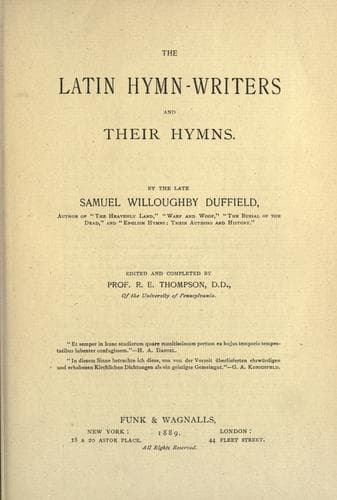
The Latin Hymn-writers and Their HymnsDuffield, Samuel Willoughby
Religion
The Latin Hymn-writers and Their Hymns
Duffield, Samuel Willoughby
Hymns, Latin -- History and criticism
It is quite amusing to read some of these effusions. He advises
Radegunda, as Paul did Timothy, to drink wine on occasion. And when the
queen and the abbess conspire to make his life pleasant he has plenty of
metrical gratitude to offer. They send him butter (_butyr_) in a lordly
dish; they furnish chestnuts in baskets woven by their own hands; they
provide milk, and prunelles, and olives, and eggs. For all these he
renders thanks in kind. Never were eggs and butter sung in a loftier
strain! But sometimes the poet descends a trifle from his elevated
phrases. He says pathetically in one of these effusions that they sent
him “various delicacies for his full stomach” (_tumido ventre_), and
that he got asleep after it and failed to furnish the appropriate
verses. He laments this in proper metre, declaring that he had opened
his mouth and shut his eyes (the old gormandizer!) and had eaten on,
regardless of his duty. And for this he craves forgiveness from his
_beata domnia_ [it ought to be _domina_] _filia_—his blessed
queen-daughter. But be good enough to observe that his own gifts in
return are very small, and that he is always apologizing and hoping that
they may not be rejected. Truly this was such a man as Sir Walter Scott
has sung, for
“The best of good cheer and the seat by the fire
Was the undenied right of the barefooted friar.”
Only it may be safely questioned whether our Fortunatus was any more of
an ascetic than Damasus himself. One almost wishes for an historical
picture—and it should be a good theme, by the way—in which Fortunatus
and his two friends appear. It should be that celebrated feast which he
describes [J. P. Migne: _Patrologia_; _Opera Fortunati_, Lib. xi., cap.
ii.], where Agnes had adorned the tables and the apartment with “every
species of blossoming plant;” where the rich wines, and the generous
fare, and the crystal, and the gold, and the flowers should brighten the
fine hall of the chateau; and where, perhaps, the ecclesiastic should
take his small harp and strike its strings with a delicate hand, while
the fair face of Agnes and the darker beauty of Radegunda should inspire
his song.
One traces to this mellow undercurrent of human life the swing of his
best lyrics—the _Pange lingua gloriosi praelium certaminis_ and those
hymns to the Virgin of which he was the earliest promoter. No ene can
doubt the influence of these women upon the _Ave maris stella_ or the
_Quem terra pontus aethera_. Say what we please about his piety, he has
written what will live with the best. And to compare him to the
melancholy Cowper, as Mrs. Charles has done, can only be characterized
as a most amusing misconception.
Public-domain text, read in full here on John Shaqi.
Reviews
Reviews
No reviews yet
Be the first to share your thoughts on this work.
Elsewhere in the archive
Join the Discussion
Join the discussion
Sign in to leave a comment or review.
Sign InorCreate an account