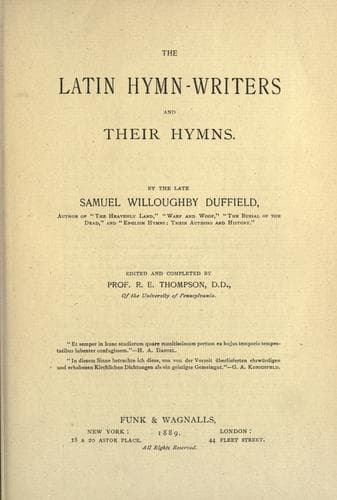
The Latin Hymn-writers and Their HymnsDuffield, Samuel Willoughby
Religion
The Latin Hymn-writers and Their Hymns
Duffield, Samuel Willoughby
Hymns, Latin -- History and criticism
We know nothing of him as bishop further than the fact that the office
became vacant in 599, and he was an available as well as distinguished
candidate. Surviving Radegunda, who passed away in 587, he died about
609, full of years and honors—the last of the classics and the first of
the troubadours; the connecting link between Prudentius and the Middle
Ages; the biographer of some of the saints and the interested collector
of many legends of their miracles; and, finally, the first of Christian
poets to begin that worship of the Virgin Mary which rose to a passion
and sank to an idolatry. Venantius Fortunatus was neither a bad man nor,
in the highest sense, a holy man. But he was a poet in spite of his
barbaric Latin, and a writer of hymns which live to-day, long after the
particulars of his career are forgotten.
CHAPTER X.
GREGORIUS MAGNUS [540-604].
The materials which are at hand for the life of Gregory the Great are,
if anything, too numerous. In their original form they include all that
Paul the Deacon (quoted by the Venerable Bede) and John the Deacon
(quoted by everybody) have chosen to relate. And these have been so
anxious to do entire justice to the great Pope that they fill their
pages with miracles, wonders, and signs, as well as with the authentic
facts of history. But Gregory carved for himself such a niche in the
temple of fame that we are not likely to go very far astray in searching
for the proper estimate of his work.
It may be safely assumed that from this pontificate dates the supremacy
of the Roman see. It was Gregory whose missionary spirit opened the
doors of Britain to the truth. It was he who, without asserting any
superior claim, opposed successfully the encroachments of the Greek
patriarchs. And it was again he who gave to the Church her sacred
melodies.
He was born, says Paul the Deacon, in the city of Rome, of a father
named Gordianus and a mother named Sylvia. These people were of the
Anician family and were also of distinguished religious descent.
Felix—fourth of the name and Pope under the title of Felix III.—was his
_atavus_, or great-great-great-grandfather. The very name Gregorius our
worthy deacon declares to be the Greek equivalent of the word
“Watchful.”
The child of such a house would be well nurtured in all the learning of
the time. Hence, he was trained in grammar, rhetoric, and dialectics—the
ancient _trivium_ or complete course of liberal education. Naturally,
too, he became an excellent scholar. And when he grew up he was called
to an important post in Roman civil affairs. He became praetor of the
city—a city which was subject to Byzantium and exposed to incursions of
various barbarian invaders. The Lombards, indeed, attacked it during his
praetorship.
Public-domain text, read in full here on John Shaqi.
Reviews
Reviews
No reviews yet
Be the first to share your thoughts on this work.
Elsewhere in the archive
Join the Discussion
Join the discussion
Sign in to leave a comment or review.
Sign InorCreate an account