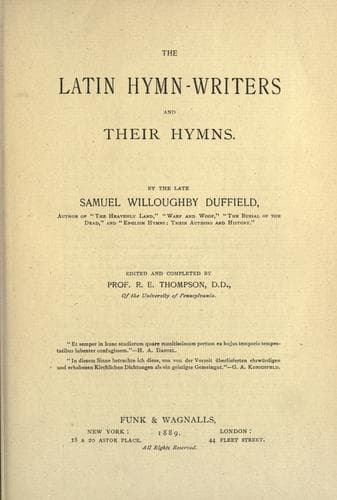
The Latin Hymn-writers and Their HymnsDuffield, Samuel Willoughby
Religion
The Latin Hymn-writers and Their Hymns
Duffield, Samuel Willoughby
Hymns, Latin -- History and criticism
Moreover, he directed his attention—as Hormisdas had done before him—to
the struggle which was never at rest between the Greek and Roman
churches. The Patriarch of Constantinople was determined to assert his
own superior claims to the veneration of the faithful. Hormisdas had
avowed—but never vindicated—the supremacy of the Pope. But his title of
_Papa_ was the result of mere adulation and never of general consent.
And the patriarch happened to be at this time the strong-willed John the
Faster—an austere and pugnacious man. It was natural therefore that he
should claim the title of Universal Bishop, and it was equally natural
that Gregory, without demanding anything especial for himself, should
resist John.
In this controversy—and in those others where his works bear testimony
to his literary and political skill—we see Gregory at his best. He is
not deficient in satire; occasionally he indulges in playful humor; but
he never forgets principle nor flinches from the prosecution of his
cause. It cannot be said of him that he proposes to overrule the civil
authorities, but he unquestionably tells them some exceedingly plain
truths. To the Emperor Maurice he wrote remonstrating against his
refusal to allow a soldier to become a monk: “To this by me, the last of
His servants and yours, will Christ reply, ‘From a notary I made thee a
count of the body-guard; from a count of the body-guard I made thee a
Caesar; from a Caesar I made thee an emperor; nay, more, I have made
thee also a father of emperors; I have committed My priests into thy
hand; and dost thou withdraw thy soldiers from My service?’ Answer thy
servant, most pious lord, I pray thee, and say how thou wilt reply to
thy Lord in the judgment, when He comes and thus speaks.” In this style
he alternately appealed and remonstrated in his dealing with the powers
that be.
To John the Faster, however, he administered gall and honey—sometimes
separately and sometimes mixed together. “Your holy Fraternity,” he
says, on one occasion, “has replied to me, as appears from the signature
of the letter, that you were ignorant of what I had written about. At
which reply I was mightily astonished, pondering with myself in silence,
if what you say is true, what can be worse than that such things should
be done against God’s servants and he who is over them should be
ignorant?” Two monks had in fact been beaten with cudgels for heresy and
finally resorted to Rome in defiance of John, where Gregory pardoned and
restored them. The Pope continues: “But, if your holiness did know both
what subject I wrote about and what had been done, either against John,
the Presbyter, or against Athanasius, monk of Isauria and a presbyter,
and have written to me, ‘I know not,’ what can I reply to this, since
Scripture says, ‘The mouth that lies slays the soul?’ I ask, most holy
brother, has all that great abstinence of yours come to this, that you
would, by denial, conceal from your brother what you know to have been
done?”
Public-domain text, read in full here on John Shaqi.
Reviews
Reviews
No reviews yet
Be the first to share your thoughts on this work.
Elsewhere in the archive
Join the Discussion
Join the discussion
Sign in to leave a comment or review.
Sign InorCreate an account