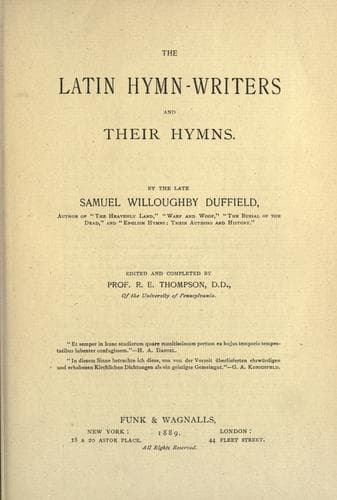
The Latin Hymn-writers and Their HymnsDuffield, Samuel Willoughby
Religion
The Latin Hymn-writers and Their Hymns
Duffield, Samuel Willoughby
Hymns, Latin -- History and criticism
If we are, in spite of this plainness, disposed to be severe upon
Gregory’s subservience to the civil power of the Byzantine Court, we
shall find an instance in his behavior toward Phocas. This man had
murdered the Emperor Maurice, gouty and helpless as he was; and had
previously put his six sons to death before his eyes. The good old
emperor died like a hero, repeating the words of the psalm, “Thou, O
Lord, art just, and all Thy judgments are right.” And we need only to
turn to Gregory’s writings to prove that the dead man was his friend and
had done him many a kindness.
Notwithstanding these gracious and excellent memories of the late
emperor, the Senate and people had hailed the advent of Phocas with
rapturous delight. His image and that of his wife had been sent to Rome,
and now, with the uproar rising to his windows, Gregory descended to the
common level of detestable approbation, and caused these images to be
carried into the oratory of the Lateran palace. “This,” says one of his
biographers, “is the only stain upon the life of Gregory. We do not
attempt either to conceal it or to excuse it.” True, Maurice had been a
vexatious old man, and his piety, while it was undeniable, was
nevertheless somewhat acrid. But the Bishop of Rome should have had
sufficient strength at least to repress any tumultuous joy over an act
of murderous ambition and hateful selfishness. This, however, is the
weakness of many a prelate. In the hour of trial he bends like a reed to
the blast, when we should expect him to be an oak, and trust to his
roots to grapple him safely down to the firm earth of principle. This
great blot, conceded by all candid historians, remains upon his memory.
It is a better picture for us to view when, forsaking his trust in the
mercy of barbarians or the senility of despotic power, Gregory looked
outward to the new nations and sought to furnish the Roman Church with
fresh vigor and vital help from this unwasted source of strength. He
corresponded with Childebert II., the unfortunate young King of
Austrasia, the son of the notorious but intellectual Brunehilda. With
him and with the French bishops he labored to secure the destruction of
“simony,” by which was meant the bargain and sale of ecclesiastical
positions. He also strove to prevent laymen from being elevated to the
episcopate, though he should have remembered that Hilary of Poitiers was
a notable argument against his fears.
He also attended to the religious matters of Spain. This province had
ceased to be Arian in 587 with the accession of Recared; and with it and
with Istria he was entirely successful in his methods of unity and
peace. He also overcame the Donatist party in Africa, who had for years
been ordaining their own bishops side by side with the regular
succession, and sometimes in actual alternation with them.
Public-domain text, read in full here on John Shaqi.
Reviews
Reviews
No reviews yet
Be the first to share your thoughts on this work.
Elsewhere in the archive
Join the Discussion
Join the discussion
Sign in to leave a comment or review.
Sign InorCreate an account