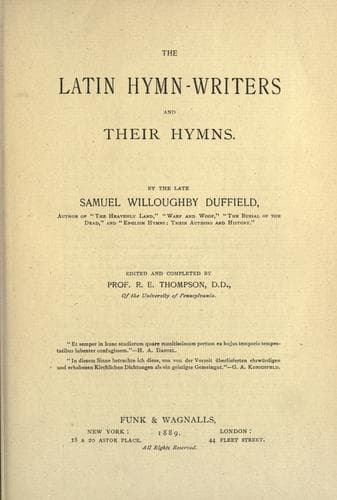
The Latin Hymn-writers and Their HymnsDuffield, Samuel Willoughby
Religion
The Latin Hymn-writers and Their Hymns
Duffield, Samuel Willoughby
Hymns, Latin -- History and criticism
To crown all, he organized a mission to the distant island of the
fair-faced Angli in 596, the very date at which the young Childebert
perished by poison in the twenty-sixth year of his age. Then it was that
Augustine, after one recoil which showed that he was not quite up to the
mark of Gregory’s zeal, finally set out in earnest with forty
companions. The month was July. The mission was almost an embassy. It
went through the intervening kingdoms endorsed to and by their kings.
And it went to cheer the little feeble remnant of the Celtic Christians
who had escaped the Saxon sword, and to draw from the Venerable Bede his
grateful tribute to the man who had already well deserved the title of
great. “For,” says Bede, “if Gregory be not to others an apostle, he is
one to us, for the seal of his apostleship are we in the Lord.”
When we remember, also, his secular services in saving Rome from sack
and pillage, we cannot but perceive that he was laying, broad and deep,
the foundations of that temporal authority which the Pope of Rome was
soon to claim. The revenues of the Roman bishop were growing enormously.
He had in Sicily and elsewhere his agents and stewards (_defensores_).
He was rapidly arising to a position of almost independent dignity. His
deference to kings was only that of Christian courtesy and love. In
another man some of this might have been disfigured by self-seeking and
moral obliquity of purpose. In Gregory we find, throughout his career, a
noble integrity which was certainly austere enough, but which was in the
main pure and free from spot. His weakness was that of overconciliation,
of which the case of Phocas is a flagrant example. But his strength was
in his just judgment and in his masterful manipulation of the materials
before him.
In his way, too, he saved Christian art as well as Christian music. He
condemns the Bishop of Marseilles (Massilia) for having broken some
statues of the saints. And while his remonstrance may perhaps be quoted
in favor of image-worship, it certainly cannot be quoted for that blind
iconoclasm which would destroy pagan beauty before the shrine of
Christian ugliness. In the association of his name with the Gregorian
chant he did almost as great a kindness to the Church as did Ambrose
when he brought to her services the Greek hymns of the East.
He was a sick man while he labored at these matters of devotion and
duty. Rheumatic gout attacked him and crippled his joints. We must add
to this that he was not without enemies, and not without many a little
sting and thrust of vicious tongues and pens. But he endured to the end,
and he probably was sincere when he wrote himself down as _Servus
servorum_—though there have been other popes since his day to follow the
custom, and who were the “servants of servants” only according to the
“devil’s darling sin, the pride that apes humility.”
Public-domain text, read in full here on John Shaqi.
Reviews
Reviews
No reviews yet
Be the first to share your thoughts on this work.
Elsewhere in the archive
Join the Discussion
Join the discussion
Sign in to leave a comment or review.
Sign InorCreate an account