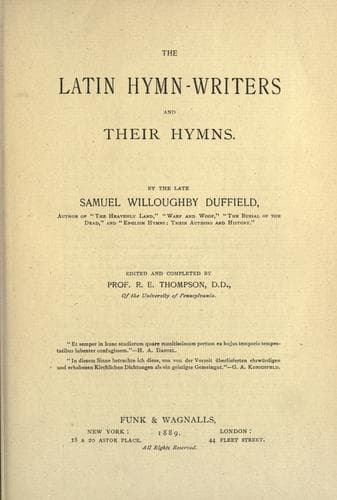
The Latin Hymn-writers and Their HymnsDuffield, Samuel Willoughby
Religion
The Latin Hymn-writers and Their Hymns
Duffield, Samuel Willoughby
Hymns, Latin -- History and criticism
Thirteen years he held the keys of St. Peter. Busy until the last
moment, he wrote or dictated the correspondence which was required. But
the disease which was upon him steadily increased until, on March 12th,
604, he was released from suffering and from care. His portrait shows
him as a man with high and wrinkled forehead; a thin beard around the
cheeks and chin; large, deep-set eyes; straight and manly nose, and a
singular lock—almost like that in the conventional portrait of Father
Time—upon his brow. There are a great many doctors of divinity who do
not a little resemble him to-day. It is a good face, but a somewhat
stern and severe one—of the sort to make credible the story that he had
a special whip for his choristers, and used it when it was needed.
His works fill several volumes in the _Patrologia_. His _Morals_, a
commentary upon Job, is the very best of his books; but he was probably
ignorant of both Hebrew and Greek, and hence his comments on Scripture
are rather more homiletical and practical than scholarly. The _Pastoral
Rule_ was translated into Saxon by King Alfred, who admired its
practical wisdom, and sent a copy to every bishop in his kingdom; under
Charles the Great also it was much esteemed in France. His _Letters_ are
the great mine of information upon his personal opinions and methods.
The _Dialogues_ were addressed to Theodolinda, and in these we find some
superstition; and indeed a fondness for saints’ miracles and a weakness
for relics were characteristic of his otherwise sensible conduct. He
wrote but nine hymns which are authentically traceable to his pen. They
are the _Primo dierum omnium_; the _Nocte surgentes vigilemus_; the
_Ecce jam noctis_; the _Lucis Creator optime_; the _Clarum decus
jejunii_; the _Audi benigne Conditor_; the _Magno salutis gaudio_, the
_Jam Christus astra ascenderat_, and the _Rex Christe, factor omnium_.
With a lesser degree of probability he has been named as the author of
the _Aeterne Rex altissime_; the _En more docti mystico_; the _Lignum
crucis mirabile_; the _Noctis tempus jam praeterit_; the _Nunc tempus
acceptabile_; and the _Summi largitor praemii_.
Public-domain text, read in full here on John Shaqi.
Reviews
Reviews
No reviews yet
Be the first to share your thoughts on this work.
Elsewhere in the archive
Join the Discussion
Join the discussion
Sign in to leave a comment or review.
Sign InorCreate an account