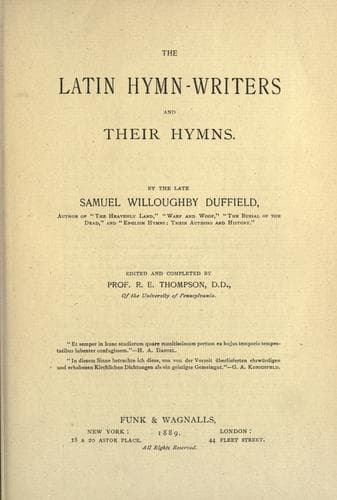
The Latin Hymn-writers and Their HymnsDuffield, Samuel Willoughby
Religion
The Latin Hymn-writers and Their Hymns
Duffield, Samuel Willoughby
Hymns, Latin -- History and criticism
Of these the _Rex Christe, factor omnium_ delighted Luther so much that
he declared it in his impetuous way “the best hymn ever written”—an
opinion which he would find few nowadays to endorse. Gregory disliked
pagan literature and cultivated the style and prosody of Ambrose. It is
possible, therefore, that among the Ambrosian hymns there may be those
which he has written and which are credited to an earlier date. But the
cause of hymnology suffers little by the loss. He was not a poet; but as
the man who made the papacy a thing and not a name—as the man who
evangelized Britain—and as the man who gave the Gregorian tones to the
praises of the Church, he will be held in kindly and lasting
remembrance. There was in him a vein of peculiar sarcasm as well as of
deep earnestness and of great sagacity, yet his literary merits are not
to be weighed against those words and actions written viewlessly on the
air, but which still effectually vibrate through the polity of the Roman
Catholic Church.
CHAPTER XI.
THE VENERABLE BEDE.
It happened with Bede as with some other Latin hymn-writers—there were
several persons who had the same name as himself. Hilary and Fortunatus
and Notker are not the only cases of confusion, for there were certainly
three Bedes, and they were not long removed from each other in point of
time. Beda Major—the elder or greater Bede—was a presbyter and monk of
Lindisfarne, commemorated by his more celebrated namesake. Another was a
holy man of the time of Charles the Great. But our own Beda or Bedan was
a presbyter and monk of Jarrow, and is distinguished from the rest by
the title of “Venerable,” which he shares with Peter the Venerable of
Cluny.
There are few finer figures in early English history. Sprung from pagan
and utterly illiterate ancestry, he has taken his place as an historian,
a scholar, a natural philosopher, and a poet; and in every department of
this varied knowledge he has shown his ability and industry. English
literature recalls him; English history praises him; English scholarship
has elaborately edited his writings, and English patriotism has
affectionately honored his memory.
Cuthbert, his disciple, who wrote his life, begins his narration in the
following words:
“The presbyter Beda, venerable and beloved of God, was born in the
province of Northumbria, in the territory of the monasteries of the
Apostles Peter and Paul, which is in Wearmouth and at Jarrow, in the
year of our Lord’s incarnation the six hundred and seventy-seventh,
which is the second year of the solitary life of St. Cuthbert.” It also
was the ninth year after the reduction of Saxon England to the Roman
obedience at the Synod of Whitby.
Public-domain text, read in full here on John Shaqi.
Reviews
Reviews
No reviews yet
Be the first to share your thoughts on this work.
Elsewhere in the archive
Join the Discussion
Join the discussion
Sign in to leave a comment or review.
Sign InorCreate an account