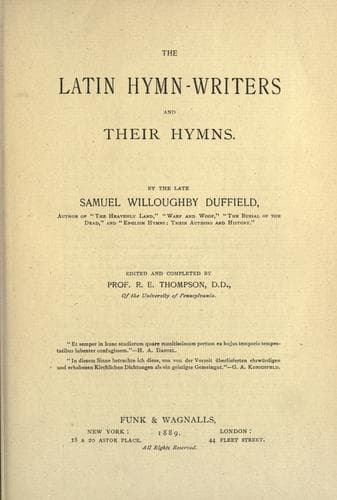
The Latin Hymn-writers and Their HymnsDuffield, Samuel Willoughby
Religion
The Latin Hymn-writers and Their Hymns
Duffield, Samuel Willoughby
Hymns, Latin -- History and criticism
Bede himself relates that when he was seven years of age the care of his
education was committed by his relatives to the Abbot Benedict and
afterward to the Abbot Ceolfrid. He adds that from that date to the time
at which he prepared the accompanying list of his works he had spent his
days in the same place. His existence was passed in meditating upon the
Holy Scriptures; and he “found it sweet,” in the midst of his observance
of the conventual discipline and daily chanting in the church, “either
to learn, or to teach, or to write.” The choice of this word “sweet”
(_dulce_) is significant, for no man could more carefully have mingled
the sweet with the useful. A gentle spirit breathes across his studious
pages, as over the rough beards of the yellow grain a breeze moves and
sways them, harsh though they are, in graceful waves. For he loved
learning with a perfect avidity. His works reveal his desire to
accumulate it—to teach it again in plain and simple fashions—and this
benevolent desire redeems many a tedious discourse.
This life of his was devoid of personal incident. He includes nothing of
his individual history in the little notices which he makes of
contemporary events, and he is singularly silent even about the affairs
of which we should think he would naturally speak. The light which we
get upon his surroundings and circumstances we must, therefore, derive
from other sources, but fortunately these are at hand. We know, for
example, that Benedict Biscop, who founded those twin monasteries in
which Bede dwelled all his life, was himself a remarkable person. He was
of noble birth, and gave up place and ambition in the court of the king
to proceed to Rome, there to be trained as a monk, and then to return
and found Wearmouth in 674 and Jarrow in 682. To the second of these
religious establishments, situated upon the Tyne, Bede was transferred
under Ceolfrid, its first abbot, and there thenceforth he remained. We
are even able to determine his usual food as a school-boy, for, says his
latest biographer, Rev. G. F. Browne, “we have a colloquy in which a boy
is made to describe his daily food in his monastery. He had worts
(_i.e._, kitchen herbs), fish, cheese, butter, beans, and flesh meats.
He drank ale when he could get it, and water when he could not; wine was
too dear.” There is, indeed, in these Saxon monasteries the honest and
hearty food which belonged to their age and people. Cedric the Saxon, in
Sir Walter Scott’s novel of _Ivanhoe_, represents very fairly the
popular feeling on the subject. Chaucer, too, can be quoted upon this
same profusion and the generosity of the time. Of the Franklin he says:
“It snowed in his house of meat and drink.”
Public-domain text, read in full here on John Shaqi.
Reviews
Reviews
No reviews yet
Be the first to share your thoughts on this work.
Elsewhere in the archive
Join the Discussion
Join the discussion
Sign in to leave a comment or review.
Sign InorCreate an account