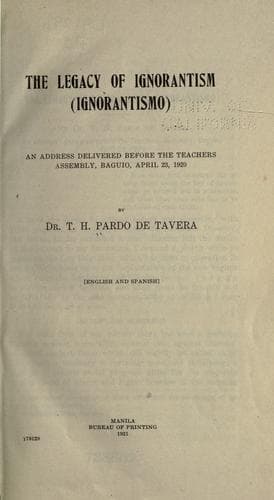
The Legacy of IgnorantismPardo de Tavera, T. H. (Trinidad Hermenegildo)
Religion
The Legacy of Ignorantism
Pardo de Tavera, T. H. (Trinidad Hermenegildo)
Church and education -- Philippines; Education -- Philippines
The Chinese half-breed is described in the same manner.
Literature for the Filipinos
The only literature accessible to the Filipinos of little culture
and also to those of the better class consisted of Corridos which
constitute the profane literature, and the Pasion and the Novenas
which formed the religious reading. Corridos, Pasiones, and Novenas
were printed in abundance, in cheap editions, in Spanish as well as
in the dialects of the country.
The Corridos are stories in verse about historic events, falsified and
fanciful, and love tragedies full of wonderful events mixed with divine
prodigies and diabolical magics--all lengthy, exaggerated, puerile, and
absurd in the extreme. None of the characters is native. All are Turks,
Arabs, knights, errants, ambassadors, dukes, warriors in armor provided
with magic arms and with balsams like the famous one of Fierabras,
good Castilians and bad strangers. All the characters are antipodal
to Philippine realities and with the semblance of the real and true
being from unknown lands and prodigious races. The same is true with
the scene of activities; wonderful lands, Palestine, the kingdom of
Navarra, the Empire of Great Kahn, the Palace of Macedonia, and not
only are they ignorant of, and do they falsify, the face of the earth,
but the planetary system itself suffers a radical change. Palms and
tamarind grow in the vicinities of Moscow; Palestine and Macedonia are
covered with prairies like Norway and Switzerland, and whales appear
in the Mediterranean. Events which begin in the morning in Macedonia
and in the most natural manner in the afternoon of the same day in a
palace of Babylonia, and a princess of Aragon captured early in the
morning in Sicily discusses at midnight and without an interpreter
with a Moro of Samarcanda.
The Pasion, a work in verse in the different Filipino dialects, is
not only the passion of Christ, but it consists of a sort of abridged
edition of sacred history.
The Novenas are religious booklets dedicated to a saint whose favor
is invoked in order to obtain from God such and such favors. They
consist of a system of prayers in relation to certain miracles with
reflections about the saint, which are said every day for a period
of nine consecutive days. To Virgin Mary is attributed the origin of
the Novenas because she venerated the number 9 in memory of the fact
that nine days it was when she was apprised of the incarnation of
the divine Messiah, and also because of the nine months in which she
carried Him in her virgin womb. (Novena to Jesus, Maria, and Jose,
Manila, 1903, in the Exordium.)
Public-domain text, read in full here on John Shaqi.
Reviews
Reviews
No reviews yet
Be the first to share your thoughts on this work.
Join the Discussion
Join the discussion
Sign in to leave a comment or review.
Sign InorCreate an account