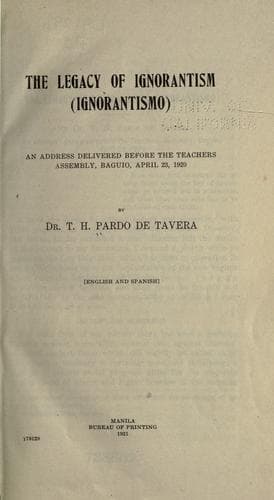
The Legacy of IgnorantismPardo de Tavera, T. H. (Trinidad Hermenegildo)
Religion
The Legacy of Ignorantism
Pardo de Tavera, T. H. (Trinidad Hermenegildo)
Church and education -- Philippines; Education -- Philippines
The Novenas offer a very simple way of obtaining from heaven what
is asked in them from a protector saint. If the sympathy and aid
of a patron or a patroness whose mediation is implored is won, one
can obtain everything, be it appertaining to earthly life or future
life. It is a very easy means. It is like a magic ceremony with
its ritual composed of praises and acts of humiliation, devotion,
submission, admiration, and other propitiatory manifestations looking
toward gaining the sympathy and the protection of the saint. This
follows an enumeration of favors which may be requested and which are
always attended to by God as demonstrated by the numerous examples
which are mentioned with scrupulous care in the Novena. All the
Novenas are published with ecclesiastical permit after the censorship
of the prelate who examines scrupulously the writings to see if there
is anything that is contrary to morals, good customs, and absolute
orthodoxy. In a word, all are printed with the necessary licenses.
The prodigies mentioned in these Novenas compare very well with
the enchantments, magics, and sorceries of the primitive Filipinos
who invoked the propitiation of their divine spirits by means of
ceremonies, sacrifices, charms, and incantations performed by their
mangkukulam (witch), babailanas, and other prestidigitators, priests,
medicine men, charmers, and fortune-tellers, which are referred to
and are enumerated in the old chronicles written by the missionaries
in the Philippines.
Substitution of "Unseen Powers"
All the fear of the mysterious as well as the belief of the Filipinos
in unseen powers which took away life, attracted misfortunes, gave
victory, or conduced to disaster was conserved, changing only the
concepts that they had about the spirits that governed the affairs
of life and the phenomena of nature. The patron saints recommended
by the missionaries came to take the place of the ancient anitos
representative of their past which they gave intervention in their
idolatry in all the affairs of life.
When the missionaries preached their religion, they condemned the old
Pagan superstitions but they taught new superstitions more powerful
than the original, not only because of the prestige of the new patrons
who are all members of a Celestial Court organized as an earthly
aristocracy and headed by the same God, Creator of the Universe,
but by communicating with God in the same tongue, which the ordinary
man supposed was spoken by Him, which is the Latin tongue, in which
the priests said their prayers and sang their hymns.
"Ensalmos"
Public-domain text, read in full here on John Shaqi.
Reviews
Reviews
No reviews yet
Be the first to share your thoughts on this work.
Join the Discussion
Join the discussion
Sign in to leave a comment or review.
Sign InorCreate an account