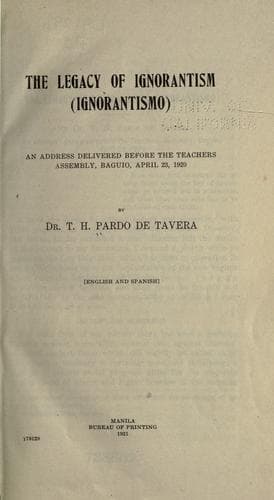
The Legacy of IgnorantismPardo de Tavera, T. H. (Trinidad Hermenegildo)
Religion
The Legacy of Ignorantism
Pardo de Tavera, T. H. (Trinidad Hermenegildo)
Church and education -- Philippines; Education -- Philippines
All secondary instruction in the Philippine Islands was under
the University of Santo Tomas. Besides the private schools
in Manila there were also some in the provinces, but all the
colleges of secondary instruction were subject to Santo Tomas.
There were primary schools in almost all the towns supported by
the Government in which a very elementary instruction was given
* * * reading, writing, catechism, and a little arithmetic.
The Filipinos, as a general rule, have good memory but without
great talent; they have no good talent.
Almost all education in the Philippines was given by the
religious orders, that is to say, the secondary and university
instruction was maintained by the religious orders, and
primary instruction by the curates of the towns.
Among the Filipinos all is imitation. They lack
originality. They were taught how to read and write Spanish but
the majority of them learned it in a purely mechanical manner.
The Indios were very averse to the Castilian language; those
who knew how to speak it did not like to speak it. This was
true in Manila as well as in its suburbs. Those who know
Spanish prefer to speak their own language in their homes.
From Fray Jose M. Ruiz in his Memoria presented to the Philippine
Exposition in Madrid in 1887, we take the following:
The curate is a local inspector of public instruction, adviser
of the gobernadorcillos, and president of the various local
boards. The Indios see in them a father, a pastor, and a
protector, and as such they have always been recognized by
the Government of these Islands (p. 239).
A great part of the Philippine inhabitants, that is to say,
that which lives in the barrios and places more or less
isolated and inaccessible, is about to be civilized (esta
casi por civilizar) (p. 247).
Referring to the mass of the people the same father says:
The masters devoted as they are, save in a few honorable
exceptions, to their proper interests, have ignored completely
the instruction of these unhappy ones in their religious duties
* * * and their children, given over to the pasture of work
animals, are reared in the midst of the most stupid ignorance
(p. 254).
Later the author adds:
To give the Indio means of instruction and to place him in
condition to benefit from it, and while this is not done,
and until now this has not been done as we shall later show,
is to concede rights to him who does not know how to appreciate
what he deserves to the disgrace of the Spanish name and to
the shame of the Spaniards in these Islands (p. 288).
Says the same Friar Ruiz:
Public-domain text, read in full here on John Shaqi.
Reviews
Reviews
No reviews yet
Be the first to share your thoughts on this work.
Join the Discussion
Join the discussion
Sign in to leave a comment or review.
Sign InorCreate an account