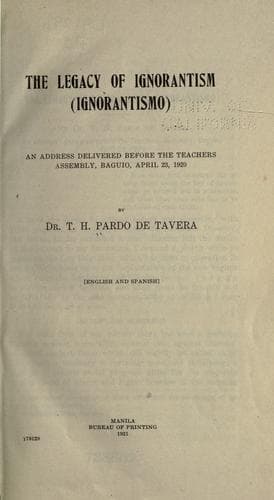
The Legacy of IgnorantismPardo de Tavera, T. H. (Trinidad Hermenegildo)
Religion
The Legacy of Ignorantism
Pardo de Tavera, T. H. (Trinidad Hermenegildo)
Church and education -- Philippines; Education -- Philippines
And altho they are inimical to going to schools (the Indios)
and to sending their children, it is because it is nothing but
for wasting time since they learn nothing * * *. Furthermore,
the towns are so crowded with ignorant teachers that without
consulting anybody they establish private schools paid for
by the parents of the children. Thus they learn what little
good and a great deal of bad which they possess, to whom
they teach Cartilla, and something of reading and writing,
utilizing as texts for both the books called Corridos, which
are full of anachronisms, errors, and absurdities of all kinds
* * *. They also learn something of the Catechism (p. 337).
The places for the schools besides being bad are completely
abandoned, and many are in ruins (p. 339).
There is no order in the school, and each one goes in and
out without permission whenever he pleases (p. 440).
Recognition of a Dominican
Fray Jose M. Ruiz very faithfully recognizes the lamentable state in
which the so-called public instruction in the Philippines was found
outside of Manila where things were not so bad. From his standpoint it
was necessary to teach Spanish and at least to give to the Filipinos
books in the dialects, from which they would learn the most elementary
things of which they were ignorant, and Religion and Moral. The Rueda
[5] translation would be better adding something about the Philippines
and the grammar of his dialect in Spanish. Undoubtedly he wanted to
say that the Spanish grammar should be translated into the dialects.
If this is not done we believe that we would only lose
time. With such measures in thirty years the Spanish language
would be diffused among the children (pp. 440-441).
For the same reason (distance and lack of roads) the boys and
girls do not attend schools, and what little they know they
learn from some ignorant teachers (maestrillos). People,
ordinarily of bad life, escaped from other towns, some of
whom are also quack doctors and bone-setters who at the same
time that they are teaching the Cartilla and a little bit
of the Catechism imbue the children with a thousand and one
superstitions and all kinds of vices. The priest who at times
goes, out of necessity, to attend to some one who is seriously
ill, and very seldom visits them (the Indios) ex-profeso,
the parochial districts being generally very large and their
duties so numerous and urgent, can only in part remedy some
of these evils.
The Filipino People
Now let us see what kind of people the Filipinos were. It is essential
to know the psychology of the community. No opinion is so valuable
for the present case than that of the missionary above cited, who
says the following about the psychology of the Filipino.
Public-domain text, read in full here on John Shaqi.
Reviews
Reviews
No reviews yet
Be the first to share your thoughts on this work.
Join the Discussion
Join the discussion
Sign in to leave a comment or review.
Sign InorCreate an account