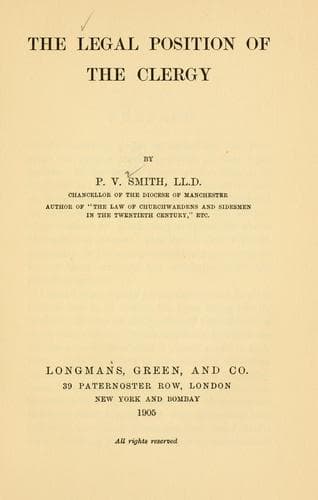
The Legal Position of the ClergySmith, Philip Vernon
Religion
The Legal Position of the Clergy
Smith, Philip Vernon
Canon law; Clergy -- Legal status, laws, etc. -- Great Britain; Ecclesiastical law -- Great Britain
20. The dues payable to the clergy are of two kinds: (i.) ordinary dues
and offerings, and (ii.) dues or fees payable for special services or
special concessions. Both kinds vary considerably by law or custom in
different places, and, as regards the former, an Act of 1548 provides
that all persons who by the laws or customs of the realm ought so to do,
shall yearly pay their offerings to the parson or vicar of the parish in
which they dwell at the accustomed four offering days, or in default
thereof at the next following Easter. Generally speaking, Easter
offerings are the only offerings of this description which are still
payable.[376] They are enjoined by the rubric at the end of the
Communion Office and are due of right, and are recoverable under the
Small Tithes Recovery Act, 1696,[377] before two justices, subject to an
appeal to quarter sessions. Their legal amount, in the absence of custom
to the contrary, is twopence per head, or, in London, fourpence per
house.[378] But these sums were fixed when the value of money and the
wealth of the country were very different from what they are at present;
and it is reasonable that voluntary Easter offerings should now be made
on quite another scale. The vicar of a new ecclesiastical parish has the
same right to Easter offerings as the incumbent of the ancient parish
out of which it was carved.[379]
21. Mortuaries or offerings at the time of a person's death are due in
certain places by custom, and, where so due, are recoverable in the
ecclesiastical courts. But by an Act of 1529, they were limited to 10s.
as the maximum and to small amounts where the deceased died worth less
than £40 in movable goods, none being payable if the deceased was not a
householder and worth at least ten marks in movable goods, and a penalty
was attached to demanding an illegal amount.[380]
22. Dues or fees payable for special services or concessions have
already been mentioned in connection with churchings, marriages and
burials, including in the last mentioned category those payable for the
funeral itself, for the grave, and for any tombstone or monument to be
erected upon it.[381]
Public-domain text, read in full here on John Shaqi.
Reviews
Reviews
No reviews yet
Be the first to share your thoughts on this work.
Elsewhere in the archive
Join the Discussion
Join the discussion
Sign in to leave a comment or review.
Sign InorCreate an account